Showing posts with label Rama. Show all posts

Monday, January 23, 2017

Book Review #104: Uttarakanda By Dr. S.L. Bhyrappa

Title: Uttarakanda
Author: Dr. S.L. Bhyrappa
Publishers: Sahitya Bhandara
Genre: Mythology/General Fiction
Pages: 350+ (Hardbound)
Source: Personal Copy

We all grew up by reading and listening to the stories of the Hindu epics like Ramayana and Mahabharata. We have a sculpted belief that a certain character from certain epic will behave like this and there won’t be any misconduct or any character deviation from their original ones. At times, these beliefs can be shaken to the ground when you come across certain books. At the same time, certain books make you question the reality. This is the very essence of the book “Uttarakhanda” penned by my favorite author, philosopher and a great human being, Dr. S.L. Bhyrappa. He finished writing this book in just 3 months of duration, but took whole 8 months to re-draft each and every chapter before sending it for the publishers. That’s typical SL Bhyrappa’s flavor.

Coming to Uttarakanda, this is the retelling of the Ramayana. But what makes it different from other writers is the theme of the book. This Ramayana is entirely from the viewpoint of Sita. How she sees the entire Ramayana as an event? What was her thought process when she decides to accompany Rama to the exile for 14 years? What were her thoughts when Ravana abducted her from the forest? Etc… The entire narration belongs to Sita in this book. How she endured all those years along with Rama and his brother Lakshmana is pictured vividly, brilliantly. This is one of the hearts wrenching narration of the Ramayana I’ve come across in my entire life.

One thing I must mention in this review, there are no gods in this version of Ramayana. Each and every character is human. Rama is as much of a human as a normal court maid. There are no flying chariots, no 10 headed Ravana but one, no curses, no divine arrows, and Hanuman is a normal 50 year old person, who believes that he belongs to the clan of the Lord Hanuman. I must applaud the brilliance of the author here for keeping the Gods as gods and making this story that touches the nerve of his readers.

As the story progresses further, we get to read the normal tale of how Rama and Lakshmana accompanied sage Vishwamitra to kill couple of rakshasas and eventually reaching the Kingdom of King Janaka, the Mithila, and breaking the Shiva’s bow to win the bride Sita. But a little twist here from the author makes it even more human. The actual plot of breaking the bow, was a setup by the King Janaka who was under the impression that, if any prince would tie the bow string with their bare hands would win over Sita, so that, the actual birth details of Sita would be negligible, since she was won in a challenge!! It is just brilliant to have this thought. It makes us to ponder for a few minutes. The after events keep Rama in high regard. Dasharatha actually learns that Sita is not the biological daughter of Janaka and she was actually found in a land while tilling. He raises an objection to the marriage and decides to cancel the wedding. By the timely intervention of Rama, this was avoided and Rama marries Sita, so does his brothers and Sita’s younger sisters.

The plot carries further in a regular manner but with a humane touch. The promises that Dasharatha made to his 3rd wife Kaikeyi has been written in an entirely different perspective which I am not going to include in this review. This must be savored from the book. One thing the readers must keep in mind that, Rama was a staunch follower of Dharma even in this version. He learns the ill motives of Kaikeyi and decides not to become Prince. As per Kaikeyi’s wishes, Rama prepares to leave Ayodhya to the exile for 14 years. The event after that takes an entirely different approach where the human nature of Rama, Lakshmana and Sita will begin to unfold.

Now the real story of how Sita tries to analyze Rama and Lakshmana and herself begins slowly. Soon she realizes that it is difficult to adjust to the forest life. Also, she learns that without Lakshmana’s assistance, she and Rama both wouldn’t have been survived in that forest. Rama was a recluse in the forest life. He was enjoying the nature with a least concern to check on his wife and her comforts.

The climax of the book will keep your mind occupied and haunts you like anything. Ravana will abduct Sita, but not by himself. He sends his troops across the sea border to bring Sita via boat. His men will do just that by tying Sita to a boat and rowing across the sea. Ravana abducts Sita for the sole intention of avenging his sister Surpanakhi who got insulted by Lakshmana. Surpanakhi instigates Ravana by narrating the events that took place when she confronted Rama and Lakshmana in the forest. She describes Sita as a beautiful lady and he should abduct her at any cost and rape her. Being a womanizer, Ravana was all prepared to get Sita to his city of Lanka. Once after the abduction, the scene was written in an entirely different fashion, where Sita confronts Ravana and asks him to win the battle over Rama. If he wins, then he can marry her. But Sita was all prepared to immolate herself if the unthinkable happens.

Once the battle was over, the real test for Sita begins when Rama doubted Sita’s chastity. He wasn’t sure whether Sita was raped by Rama or not (sic). Having spent more than a year in another man’s supervision, Rama doubted whether to take back Sita or not. This is an eye opener scene for the reader. When Sita questions the same thing to Rama about his chastity for spending more than a year away from her, Rama didn’t have any answers. Sita’s questions are a mirror test to the present society. Is chastity applicable only to women? Who made this rule? Won’t men also fall under this category? Why women are termed as spoiled when she was raped or abused? Why the same things do not apply to men? Are men not under the purview of rape? Won’t they get raped by women? All these questions of Sita hits the bulls eye to the present society that questions that chastity of a woman or term her as raped when it wasn’t her fault? Rama’s unwillingness to answer these questions denotes the situation of every man in the present society.

The final confrontation of Sita with her husband Rama was a true testimonial of how bad the decisions that Rama took against Sita. When she confronts Rama asking him about his conduct with sage Gautama, asking him to forgive his wife Ahalya when she committed adultery 25 years back, and why he can’t he do the same? When Rama can bow down before a low born woman Shabari and consider herself as his mother, why he went ahead and beheaded a low born man who was doing tapas and reciting Vedas? Rama’s reason was like low born persons shouldn’t do the tasks that belong to the higher born persons. What kind of Dharma he is following? For all these things, Rama was not able to answer anything.

Overall I believe that book showcases the patriarchal society of Rama’s era and why it hasn’t changed even a bit in the 21st century today. Questioning a woman on her every move is still prevalent in the current society. Rama was no exception either. He just behaved the way he believed it was according to the Dharmic principles. He didn’t even shown the human side of him to the world. Though we revere and celebrate his life and keep him in high regard as the epitome of the justice, but how he wronged Sita will remain as a black mark on him till the earth survives. A must read book. You can go back to the earlier writing flavor of S.L. Bhyrappa. I would definitely rate this book beyond 5 stars and recommend it to every reader.

My Rating:
5/5
Wednesday, March 23, 2016

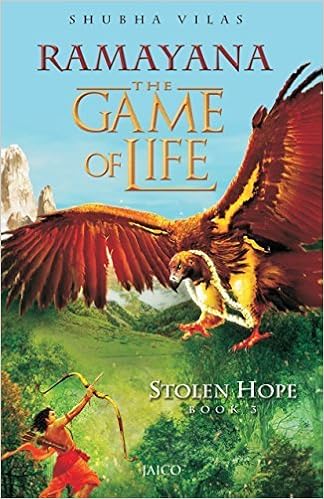
Book Review #81: Stolen Hope: Ramayana Series: Book #3: By Shubha Vilas

Title: The Stolen Hope (Book 3: Ramayana Series)
Author: Shubha Vilas
Publisher: Jaico Publishing
Genre: Mythology
Pages: 300+ (Paper bound)
Source: Review copy by the author


After receiving this book from the author for the review, I’ve thought for a while and purchased the first two books in the series (The Rise of the Sun Prince, and The Shattered Dreams) to get along with the plot and the subplots. Though as an Indian, I’ve known the entire story of the Ramayana and how it had happened by reading numerous books, this book series seems to be very specials regarding its authentic style of narration and the anecdotes, life lessons explained in every page of the book.

The book 1 explains about the birth and growth of the Rama as a toddler to a responsible scion. The book 2 explains the details about the decision of the King Dasharath to coronate Rama as the next king of Ayodhya, and the later events of Kaikeyi asking her two boons from the King Dasharatha resulting in the banishment of Rama to the exile for 14 years and Bharata to be made as a King of the Ayodhya, hence the dreams of the Dasharatha has shattered.

The book 3 begins from the story of the Dandakaranya where Rama, Sita and Lakshmana planned to spend their exile of 14 years. The journey of all three in the forest, their encounters with several rakshasas, and meeting several learned rishis like Agastya, and also the intervention of the Surpanakha and a small fun incident with her that turned out to be a major breakthrough in the story has been captured brilliantly by the author. The killing of Surpanakha’s cousins Khara and Dushana in an epic battle, and a beautiful narration of Rama meeting Shabari has been explained elegantly.

With a brief history of Ravana the story moves on stealthily and Rama is urged to go after the golden deer who is actually Maricha. Then Sita urges Lakshman to go after Rama despite of his unwillingness after hearing her husband's cry.

Ravana comes in form of sinister sage and he praises Ravana and belittle Rama, but Sita praises Rama instead which infuriates Ravana and he takes away Sita. Sita could only inform Jatayu about her abduction. Rama is informed about the abduction by dying Jatayu. Rama meets Shabri who tells them that only Vali can help him find Sita.

There is a short part of story from Lakshman's point of view too.

In-between the relay of the events, the author discusses and analyses certain acts of characters. For instance, at one place, Sita boldly reveals her mind to Rama about choosing the ascetic life instead of his bow and arrow, and immediately the next moment, she could not hold his gaze and begins to stare at her palms. That is, she feels guilty to have counselled Rama. Here the author discusses Sita's act of giving feedback as follows:

Does one have the right authority to give the feedback?
Even if one has the right authority, does one have the right motive to give a feedback?
Even if one has the right authority and motive, is it the right time, place and circumstance to give the feedback?

Although this story is written in parts, it doesn’t feel like it is limited to any particular storyline dividing the epic. The addition of little less important stories all along the way across the entire book has added much value as it would be very useful for the first time readers to obtain sufficient knowledge about the epic. The book is written in a gripping way that it is hard to keep it down, but it seems to be little bit lengthy as we tend to study each and every footnote at the bottom. But to a normal reader the footnotes would provide a Maslin of thoughts which will be forgivable for the length of the reading time.

This book is a must for the readers those who want to know about the Ramayana. Also the author has made this one to be a useful notes by sharing his wisdom and thoughts in every page. Further the summary of the books at the inception of the book makes it clear for the new readers that it’s not a must to read the other two initial books to get a clear view about this particular book.


My Rating:

5/5

Book Review #80: Shattered Dreams: Ramayana Series: Book #2: By Shubha Vilas

Title: The Shattered Dreams
Author: Shubha Vilas
Publisher: Jaico Publishing
Genre: Mythology
Pages: 250+ (Paper bound)
Source: Personal Copy

The first book in the series (The Rise of the Sun Prince) will end on a happy note of 12 years of successful marriage of Rama to Sita. They enjoy each and every day like never before. They were the true testimonial of how a married couple should behave towards each other. The book also explores further into the growing up Rama where he takes his responsibilities seriously and serves his elders with utmost respect. All days were passed without any deviations. People of Ayodhya were able to lead a peaceful and prosperous life until the King Dasharatha decides to coronate his son Rama as the next heir apparent of the Ayodhya.

The Shattered Dreams narrates the entire story of how the unblemished Rama was unfortunately awarded the exile of 14 years. How the deceitful Manthara was successfully able to brainwash Queen Kaikeyi by asking her to remember her two boons from Dasharatha that he had promised her long back.

The story in this book showcases the sacrifices made by many people including Rama who happily agreed to go to the forests for 14 years without even asking a single reason. He had respected his father Dasharatha’s words by every bit of it. Sacrifices made by Sita who readily asked Rama to take her to the forests along with her. Though she was never accustomed to the life of forests, she lived up to her name following the Dharma as a loyal wife of Rama. Apart from these, there is a radiant Lakshmana who accompanied Rama and Sita despite the strong protests from both. And lastly, we should never forget the sacrifice made by the wife of Laskmana’s wife Urmila. She readily agreed to stay back and look after her aged and widowed mother-in-law’s and wished all the success to her husband Lakshmana.

All said and done, the conduct of Bharata is worth to mention here. He readily disagrees with his mother Kaikeyi and repents for not being around in Ayodhya when all these things has happened without his knowledge. He ridicules his mother and tries all his might to get his beloved brother Rama back to Ayodhya. When Rama declined to the requests of Bharata, Bharata made sure that he also never steps in to Ayodhya. He constructed a small hut outside Ayodhya and placed Rama’s footwear on the throne and was ruling the kingdom on behalf of Rama.

Though we have grown up hearing this epic from various sources and watching many television series covering the same but after reading this book, one would definitely understands the real meaning of the tale and how it can be adopted to real life scenarios.

The footnotes and anecdotes in every page is the biggest plus point in this book. It adds a great value to the story. The notes are very educative, knowledgeable and a great source of quotes for those who are quote collectors. There are also great leadership and management lessons given under various circumstances. Two particular incidents worth to be mentioned on this aspects are the questions that Bharata asks himself whether he is eligible to rule the kingdom and the other scenario where Lakshmana asks himself whether he is allowed to advice Sita or Rama.

Overall, I have experienced a very new tale of Ramayana. Leaving its main plot as a known phenomenon, I have also had the fortune of reading many sub-plots and intricate details of the Ramayana. This book series is a must read to get a new perspective of how to look at things from a more broader perspective and definitely an eye opener towards myriad duties and responsibilities which we forget to value at times.

My Rating:

5/5

Thursday, September 18, 2014

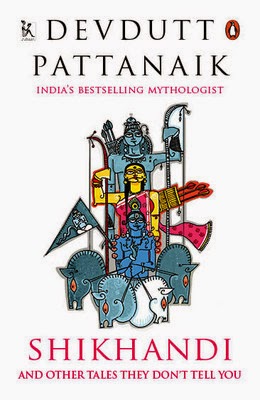
Book Review #36: Shikhandi and Other Tales They Don't Tell You By Devdutt Pattanaik

This is short and very informative book on the most infamous QUEERNESS ideology in India and other parts of the world. He has researched every nook and corner for the queerish tales from the epics of Hindus and several queer examples from the Greek, Egypt and China as well.

This book is an important book for India and Indians considering the LGBT community is not getting enough support from the government for their recognition in the mainstream world. To add ghee to the fire, Our Indian supreme court has ruled out a judgement an year ago which was against the LGBT community. So, these people became criminals and outlaws overnight. Author Devdutt has written an excellent piece of information that serves as a befitting reply to all those moral policing morons that roam around in the country in the name of culture and tradition.

This book is just about 170 odd pages covering close to 30 short stories of queer people from the Puranas, Vedas and epics such as the Mahabharata, Ramayana, etc.. Devdutt also established the context of "Queerness" from the global mythological sphere bringing stories from Vikings, Egyptian Gods, Chinese legends, Bibliographic readings, etc..


In the first half of the book Devdutt explains the pretext behind this "Queerness" and its origins from various places around the world. Later in the 2nd half, there are 30 stories that was available from the Mahabharata, Ramayana, Puranas, Vedas, from even the gods, etc..

Having read his previous books JayaThe Pregnant King and Sita, I was aware of most of the "QUEER" stories that he has captured in this book. Especially the story of Yuvanashva from The Pregnant King is a fantastic one. Also, I was well accustomed to the stories of Shikhandi, Mohini, Brihannala, Ardhanareeshwara, etc.. I am glad that I came to know about many other queer characters such as Chudala, Gopeshwara, Aravan, Sudyumna, Makara, Samaran, Alli, Pramila, Samba, etc.. The fascinating tales of Narada the messenger forgets that he was a man, God Krishna is a cross-dresser and most of all, Rama when he was leaving for his 14 years of exile, he informs his fellow citizens to head back to the kingdom and wait for his arrival, but addresses them as "All you men and women of my kingdom, please go back to Ayodhya and wait for my arrival", and Rama forgets to address the Queer people who didn't go back but stayed on the banks of the river. Hence, all these people of Queer nature wait for the arrival of Rama at the same river shore where Rama had left 14 years earlier!!.

These are amazing tales that proves time and again that Queerness is not a crime and it is existed since time immemorial. Author has added an excellent note from the vedas at the end of the book which says "Vikruti Evam Prakruti" that can be translated as "Queerness too is a part of nature".

My Rating:
4/5

Monday, July 14, 2014

Book Review #23: Asura - The Tale of the Vanquished By Anand Neelakantan

As I started reading this book, I was in a hope to understand the Ravana's side of the Ramayana. As the author himself proclaims at the end of the book "And in the pages of history, as always, it is the version told by the victors, that lives on. The voice of the vanquished remains lost in silence." I was thrilled to read this line and I was all ears to hear the Ravana's version of the Ramayana. What the mightiest Ravana has to offer us, the mere mortals, about his version of events that unfolded in the name of Ramayana.

Well, the book picks up really good, opening up with the soul of Ravana gazing upon the remnants of what is called as an epic battle and was thinking in his mind about what all the events that led to his downfall, the downfall of the mightiest king that India or was it the Lanka ?? has ever produced?.

Later what is I expected of the book all went in vain. I judged this book by the cover of it, literally. This is not Ramayana. Instead, it is Ravana-yana.Let's give the benefit of doubt to the author, who said, this is a work of fiction. So, expected a little damage to the original mythological epic that was revered with at most respect and kept at high regards among Indians ,well, Hindus.

As the book unfolds in subsequent chapters, I realized, wait..., this is not I am expected to read, right ??. I continued, Author had no clue what he was telling in every chapter, with an urgency to finish of this book, author had done great damage to the original version of Ramayana and went a step ahead to give a character certificate to Lord Rama.

Let me get some of the points I thought it is disgusting:

The Writing Style and Editing:
Author had not realized the numerous spelling mistakes and errors in sentences formation. When an author is capable of writing such a huge volume, It is expected to make some grammatical errors. But, not in this case, he doesn't even know the difference between "STRUCK" and "STUCK", "ADVISE" and "ADVICE". This is repeated in various section, and I had to bear the entire novel, correcting the grammar myself and continue to read. I don't even know what sort of proof-reading has been applied for the novel. You would read it anyways. Enough said for this grammatical aspects.

Writing Style:

This must and should be mentioned without fail. As I read through the novel, Author depicted Ravana as a fickle minded person, who is not sure of what was going around him. And, author let Ravana continue in that stage throughout the novel. Poor Ravana, I thought, he is schizophrenic. Later, realized, it is the author, who is not capable of maintaining the order while writing the events. At times Ravana seems to be happy and content, and in split seconds, he is sad or angry. In one of the chapters, Ravana is holding his Prime Minister Prahasta's dead body and utters something "I always loved you and want to scream to the world that, you are one of the nicest persons I have ever met" and in next sentence "But, I didn't liked the advices you were bestowing upon me, hence, I would hate you for that". From love to hatred in just 4 sentences???!!!. What the f***??. Common man, I do not have time for this fickle trail of words from you.


Protagonists:
The story unfolds between 2 main protagonists. Bhadra, the self proclaimed, close aide of Ravana, who sprung into action from nowhere. And, the main protagonist Ravana.

Bhadra a close aide of Ravana, or, that's what he thinks. He comes from nowhere in the novel and declares his unconditional support to Ravana. He declares, Ravana as the king he was looking for all these years and he can vouch for Ravana, who can battle the "BAD" Devas and restores the "GOOD" Asura rule throughout the India.


I never seen a disgusting character as Bhadra's. He is a spineless, jobless, character less, drunkard who always finds himself in ditch. Any story narrated by him has the final ending of seeing him in a nearby ditch. But, why ??. Author had to explain to us. Bhadra's version of story is truly disappointing, he always finds himself in mess, his thoughts runs like a gutter water, he has no clue what was going around him, neither author helps him to regain his lost glory. Bhadra has a wife and daughter, who never appears in the novel, rather he wanders wagging his tails before ravana, he do not have a purpose in life, he was used as a mere pawn by Ravana or he gets this opportunity himself ??. Sometimes he loves Ravana, he does anything to gain Ravana's trust, he kills Ravana's sister Soorpanakhi's lover, he poisons Kubera's entire army, but still he was not recognized by Ravana, why??, Towards the end, he outrages against Ravana, he kicks ravana's dead body and he leaves lanka and settles in Ayodhya??. I mean what the f*** again??. Why we have to bear so much confusion is one single character ??.


Ravana is as confused as Bhadra or rather more. He has no clue what was happening and why was happening. All he wanted was to becomes the king of Asura empire. Author had miraculously wiped off all the values that many people have kept on several mythological characters. Brahma becomes the Asura teacher, Shiva becomes the Asura god and Vishnu is a bad ass. Why??, you won't even find a clue in the book. All his life, Ravana thought Devas as bad, Brahmins are bad. He thought, Brahmins and other North Indians hated the black people. Author's constant use of words "BROWN", "BLACK" and "WHITE" while describing people shows how much hatred that author is imbibing into people's mind. It is better not to mention Ravana's character much, as people will lose all the respect that Ravana has gained all these centuries. It is pointless.


Ravana realized that Sita will not be happy with Rama (with just an assumption!!). Hence, he abducts her. What the f*** again??. Author goes on supporting this claim that, all these white skinned aryans, and brahmins are not good. They will not take of their wives.


Some points worth to be noted:

As per the author,

  • Lord Rama commits suicide by realizing that he has done grave injustice to Sita mata.
  • Sita mata commits suicide by jumping off to the Sarayu River, when her chastity being questioned by the citizens of Ayodhya. This is such a bad interpretation, I am sick about the author.
  • Lakshmana will be executed by the orders of Lord Rama, because people accused Lakshmana for not taking care of Sita mata in the forests.
  • Maricha's the close aide of Ravana, disguised himself as a golden deer by wearing a deer skin and jumping around like a mad deer infront of sita!!. OMG!!!
  • Sita Mata, is none other than the daughter of Ravana, who had a sexual relationship with Vedavati when he was in a battle against Devas.
  • Lord Rama was beheading all the people (of low caste) who was reciting vedas.
  • According to the author, entire India spoke Tamil, so if someone seen speaking in Sanskrit, has instantly became an alien language.
  • Mandodari, the wife of Ravana, will be abducted and raped by Hanuman, Angada and his troops. (Sick)
  • Kumbhakarna is a big time drunkard, who was always high.
  • Brahmins always hated the Black skinned people.
  • Vibhishana, Varuna are portrayed as a mere traitors, because they joined Rama's army.


At the end of the novel, Author had given some 3 chapters of how the caste system has evolved. He writes that, Rama has pronounced Vibhishana as the king of Lanka. And, Vibhishana has abolished all the asura practices and introduced all the vedic practices. He writes that, vedas are the root cause of Jati and Varna system in the country. He narrates through Bhadra that, all the vedic rituals led the people of lanka to migrate to different parts of the world.


I am so flabbergasted while writing the review of this book. So much to vent out, but not sure where to begin and end. I am sure my central amygdala has gone haywire. Credits to the author.!! :). I can sum up the entire alternate version of the story in few lines:

Ravana: "Hey you, all my supporters, what's up dawgs ??. Well, as you can see, there was nothing under my control, and all happened in quick sessions. I do not even have time to protect y'all. All I wanted is to become just a king. I am not responsible for all your miseries and difficulties. I should've realized this long ago. May be instead of becoming a king, I should've chosen music or teaching or something"


What I liked about the book ??

ENOUGH SAID!!!


My Rating: 1/5