Showing posts with label Mahabharata. Show all posts

Thursday, September 18, 2014

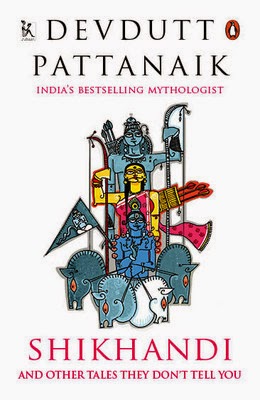
Book Review #36: Shikhandi and Other Tales They Don't Tell You By Devdutt Pattanaik

This is short and very informative book on the most infamous QUEERNESS ideology in India and other parts of the world. He has researched every nook and corner for the queerish tales from the epics of Hindus and several queer examples from the Greek, Egypt and China as well.

This book is an important book for India and Indians considering the LGBT community is not getting enough support from the government for their recognition in the mainstream world. To add ghee to the fire, Our Indian supreme court has ruled out a judgement an year ago which was against the LGBT community. So, these people became criminals and outlaws overnight. Author Devdutt has written an excellent piece of information that serves as a befitting reply to all those moral policing morons that roam around in the country in the name of culture and tradition.

This book is just about 170 odd pages covering close to 30 short stories of queer people from the Puranas, Vedas and epics such as the Mahabharata, Ramayana, etc.. Devdutt also established the context of "Queerness" from the global mythological sphere bringing stories from Vikings, Egyptian Gods, Chinese legends, Bibliographic readings, etc..


In the first half of the book Devdutt explains the pretext behind this "Queerness" and its origins from various places around the world. Later in the 2nd half, there are 30 stories that was available from the Mahabharata, Ramayana, Puranas, Vedas, from even the gods, etc..

Having read his previous books JayaThe Pregnant King and Sita, I was aware of most of the "QUEER" stories that he has captured in this book. Especially the story of Yuvanashva from The Pregnant King is a fantastic one. Also, I was well accustomed to the stories of Shikhandi, Mohini, Brihannala, Ardhanareeshwara, etc.. I am glad that I came to know about many other queer characters such as Chudala, Gopeshwara, Aravan, Sudyumna, Makara, Samaran, Alli, Pramila, Samba, etc.. The fascinating tales of Narada the messenger forgets that he was a man, God Krishna is a cross-dresser and most of all, Rama when he was leaving for his 14 years of exile, he informs his fellow citizens to head back to the kingdom and wait for his arrival, but addresses them as "All you men and women of my kingdom, please go back to Ayodhya and wait for my arrival", and Rama forgets to address the Queer people who didn't go back but stayed on the banks of the river. Hence, all these people of Queer nature wait for the arrival of Rama at the same river shore where Rama had left 14 years earlier!!.

These are amazing tales that proves time and again that Queerness is not a crime and it is existed since time immemorial. Author has added an excellent note from the vedas at the end of the book which says "Vikruti Evam Prakruti" that can be translated as "Queerness too is a part of nature".

My Rating:
4/5

Friday, September 5, 2014

Book Review #33: The Pregnant King By Devdutt Pattanaik

My fawning over the tales of Mahabharata and its oddities never stops. It is rich, it is endless and it is window to witness what one could’ve only imagined. I have become a great fan of Devdutt Pattanaik after reading his Jaya (Retelling of Mahabharata), Sita (Retelling of Ramayana) and Business Sutra (Management from Indic point of view). He is a true master in compiling the mythological stories. Pattanaik, a medical doctor by profession and Mythological writer by passion, Pattanaik have written his first ever fictional tale that will juxtapose against the tales of the Mahabharata.


I took this book by only reading the title of it. It is strange, isn't it ?. How on the earth ***** ? As you can exclaim!! :). This is the tale of Yuvanashva, the king of Vallabhi, a descendant of Turvasu clan. Vallabhi a city placed adjacent to the kingdom of Kauravas, the Hastinapur.

The novel picks up really well with the introduction of Yuvanashva parents, his father Prasenjit that dies very early, which leads his mother Shilavati to rule the kingdom. Here author brings up a very interesting argument over, why women cannot become the king and sit over the throne, which is a must read from the book. All the villagers and other neighbor kings were not really in acceptance mode, when shilavati was ruling. This was adharma according to them. Hence, Shilavati just became a proxy ruler, until his son is blessed with a child, that’s the right time to allow him to become the king.

To everyone’s dismay, Yuvanashva remained as childless though he was married to 3 different queens. His first wife Simantini, Second wife Poulomi and third wife Keshini. These characters are just the filler roles for this novel. There is not much about them that you can guffaw over it. Hence, Yuvanashva conducts a ritual by calling the sages Yaja and Upayaja to prepare a magic potion by offering richly to the gods through Yagna. But, unfortunately, Yuvanashva drinks this potion accidently and he becomes pregnant! :)

What follows after this accident is a splendid art work of fiction. Author had brought the woman in Yuvanashva through his tales of emotion, happiness and feelings. Yuvanashva's dilemma/jignasa over whether his firstborn son Mandhata, should call him MOTHER or FATHER ?. Whether he can announce the world that, he has given birth to Mandhata ? Whether the world will agree to such story?, etc.. To his surprise, when he revealed this secret to his son Mandhata a few years later, Mandhata also silences Yuvanashva citing the reason “Whatever happened has happened, now I am your son and you are my father”. Yuvanashva pleading his son Mandhata to call him as MOTHER at least once is one of those highly charged scene from the book.

Though this entire story takes place at the time of Mahabharata, The story of Vallahi and Yuvanashva takes the cake. The people of this kingdom were least bothered about what’s happening in Hastinapuri. One such example is when a bard comes and announces that, all the Kaurava army was destroyed in the battle of Kurukshetra, everyone exclaims “Oh, is it so??”, then they carry on with their regular chores. :)

Yuvanashva is one of those kings who don't participate in the battle of Kurukshetra, reason being obvious, he is pregnant. There are multiple references to bulls, fields, soil and seeds as euphemisms for sex and conception, and to illuminate the vexing question of “ownership” that arises when a woman is made pregnant by someone other than her husband (famously called as NIYOGA system). And then there are those troublesome dead ancestors, the “pitrus”, waiting for the arrival of a child so they can be reborn in the land of the living. Taking the form of crows, they perch outside bedchambers, waiting for quick results, flapping their wings impatiently when foreplay goes on for too long. (“Does it not bother you that your son’s seed is weak?” one of them indelicately asks Shilavati.) The book is bit "for adults only" too, that doesn't mean that, it is disgusting to read. I guess it is appropriate for the tale that the author is describing.

There are other supplement tales. Two best friends Sumedha and Somavat(i), their tales of how they were supposed to get married and it was severely dealt by Yuvanashva, by burning them alive. Later they became ghosts and were tormenting Yuvanashva.  These ghosts are responsible for Yuvanashva drinking the potion that was meant for his wives. It’s an interesting section to read. Shilavati, who cannot rule as a king because she is a woman. Pruthalashva (grandfather of Yuvanashva), who must sire a child because he is a man, a Yaksha named Sthunakarna, who surrenders his manhood so thatShikhandi (a woman) can become a man and a husband, and later reclaims it, and of the great warrior Arjuna with his many wives, who is forced to disguise himself as a woman (Brihannala) when a nymph (Urvashi) castrates him. And in this journey, we witness King Yuvanashva's struggle to be just to all, his conflict with himself, and his duty to bring about Dharma in his kingdom.

The climax part is what gave an amazing conclusion. Yuvanashva decides to renounce as a king and becomes a hermit. He wanders through the forests meeting sages and other learned rishis. He realizes there is more to life than what he had imagined. He slowly raises his consciousness and becomes Nilkanth Bhairavi or Yuvaneshwar.

Overall, this is a sporadically successful, intriguing, spectacular, beautiful, yet thought provoking book that tells an engrossing, subversive story but meanders a little too much.


Some of the quotes which I liked from all the characters:

- "What sounds sweetest, being called Mother or being called Father"?

- “Does it not bother you that your son’s seed is weak?”

- "You are assuming you know the boundaries of nature. You don't. There is more to life than your eyes can see."

- “Who is a King? Who can claim to be mother or a father? Who is the rightful heir to the throne?”

- "To be a woman is like becoming a prey, her every move watched by hungry predators. Every glance of man is a violation. No one is spared. No one. Not mother, not sister, not daughter. It is only fear of Dharma that keeps men in check. (Arjuna describing his story to Yuvanashva when he became Brihannala for one long year)"


The realization quotes of Yuvanashva:

- “It will not make sense to your logical mind. You will say, a parent is a parent, whether you are father or mother. But it is not the same. I cannot explain. You have to experience it. All I know is what I feel. I feel, while there is sweetness when your son calls you “father”, there is more sweetness when he calls you “mother”.

- “I am not sure that I am a man…I have created life outside me as men do. But I have also created life inside me, as women do. What does that make me? Will a body such as mine fetter or free me?”

- “That’s what they were. Vehicles of an idea. Two ideas. No. One idea, two expressions. Two halves of the same idea. Mutually interdependent” - (on being Male and Female).

- “Within you is your soul, Adi-natha as Shiva, silent, observant, still. Around you is matter, Adi-natha as Shakti, ever-changing, enchanting, enlightening, enriching, empowering”.

- “The imperfection of the human condition and our stubborn refusal to make room for all those in between”


Endnote (Quote) by the author:

“Did the events actually happen? Does it matter? Is it really about Shilavati, Yuvanashva, Shikhandi or Somvati? Or is it about love, law, identity, gender, power and wisdom? The impossibility of universal fairness?”

My Rating:

5/5

Monday, August 25, 2014

Book Review #30: The Palace of Illusions By Chitra Banerjee Divakaruni

Who doesn't love Mahabharata ?? An epic of thousands of tales intertwined together in a mesmerizing story. And even more awesome feeling is, when you read the same Mahabharata story in different angles, different perspectives and different dimensions. All in all, a book which is certainly unputdownable. After reading many books on Mahabharata, especially after providing the review of Parva and Jaya in my own blog. I am here to give you all, yet another version of the tales of dice or simply the Mahabharata.

As the title of the book itself says, this story is all about the Illusionating Palace that Draupadi had dreamed off. The title is so apt for this book, since, the main theme of the book revolves around this palace. Divakaruni's attempt of narrating The Mahabharata from Draupadi's point of view is an excellent feat. Keeping Draupadi as the main protagonist of the novel, Divakaruni had achieved full effect the novel for what it meant to be. Loaded with heavy feminist viewpoint, you get to read the complete, different Mahabharata from Draupadi's point of view. Even arranging the chapter names is in a different style, as it is not numbered, rather, it is the theme of the story that she is narrating in that chapter. For example: Chapter name is Fire - it contains the Yagna that Dhritarashtra performs in the name of Rajasuya Yaga.

I am not going to give you all a review of Mahabharata here. That has been told many times over and over again. Here I will highlight the events and actions that unfolds through the eyes of Draupadi.

What was much fascinating was, Divakaruni's attempt of picturising Draupadi or Panchaali (The way she expects everyone to call her) is vivid and full of surprises. Draupadi also enjoyed the name "Sakhi" and "Krishnaa" (the female version of krishna) when Krishna used to call her. Draupadi's childhood is not a regular childhood of any little girl, since, it follows a different route. Draupadi, who was raised by his fond Dhai Ma, had a different view of the world such that, she always opposed the ritual of Women were not allowed to enter the Royal Courtroom, Women were not supposed to study after a certain point, Women had no choice of her own while selecting her groom (Yes, the Swayamvar!!), etc. etc..

Throughout the novel, we can get to see the lost love of Draupadi for Karna. Draupadi always longed for the love of Karna, which is not by compulsion, but by pure love. She had admonished him in the Swayamvar proceedings of his lower birth, not knowing Karna's true birth!!. Almost in every chapter, Draupadi's love for Karna is described very passionately, which is a must read from the book.

Without forgetting, having married off to 5 Pandava brothers, Draupadi had her share of fight or rather doubts against Kunti, her mother-in-law. She had to start her daughter-in-law life afresh in the new house, adjusting to the environments, getting along with people,etc.. You will sure enjoy the regular SAAS-BAHU cat-fights from this novel. When Draupadi learns that, Kunti had approached Karna to reveal his true birth and offered Karna to becomes the Sixth husband of Draupadi, towards the end of the novel!, Draupadi loses her cool and was about to shout at Kunti for not bringing this to her notice!!. This is for sure a spiced up story to read from the book.

What at all a review, if I do not bring the Palace of Illusions ??. This is the main theme or crux of the novel as I said before. What follows after their lac house was burnt and they get their share of barren land Indraprastha to start a life. Pandava's had called Maya to construct a beautiful palace that was never done before and will not be done after. As expected from this women centered novel, Draupadi becomes the chief architect for planning and suggesting what and all to include in this palace. The pillars, The waterfalls, The fish ponds, The rooms, The walls, The paintings, etc.. Everything was done according to Draupadi's instructions, which is the sole reason or the stepping stone for the entire Mahabharata. When Pandava's invited Kaurava's to visit their palace of Illusions, with much to the dismay, when Duryodhan accidently steps on to a pool which was looking like a glass floor, followed by Draupadi mocking him in front of her maid-servants, that led to the game of dice, followed by War of Kurukshetra is all a regular telltale!!.

Surprising stuff which I believe is that author's brought up story is, Draupadi had a boon from Sage Vyasa that, she can visualize the happenings across a far away place. When she was younger, Vyasa had already informed her that, she will be the main reason for thousands of deaths, also, she will get married to 5 brothers, etc.. Even in the war of kurukshetra, Draupadi already knew who Karna was, and she was tempted to reveal this to her husbands, which she didn't do, since, Vyasa asked her not reveal anything until what he wrote already must happen. 2 things we must notice here, First Vyasa giving boon to Draupadi to visualize future but not to reveal anything. And Second, Vyasa had wrote the Mahabharata much before it took place ?? (This is sure a debatable topic)

Towards the end of the novel, all Kaurava's side have been killed and Pandava's side have ruled for several years and it was time to take up the vanaprashta-ashram. 5 brothers along with Panchaali heads towards Himalaya that ascends to the greater heavens. The struggle and the hardship that Draupadi goes through this phase is a treat to read from the book. Because, Dhritarashtra had told his brothers that, none of them will help anyone if they fell down while ascending the himalayas. So, as foretold by the oracles, Draupadi falls much before. But to our surprise, Divakaruni had brought Krishna in this scene, who will lead Draupadi into the safer heaven.

Overall, a fresh aspect, a bold attempt of Mahabharata or I can call it as Panchaali's Mahabharata!!. A section of Krishna teaching Bhadagawad Geeta to Arjun was kept bare minimum, which should've been extended a bit further. Other than that, a must read book for all those historical fiction buffs.

My Rating:
5/5

Monday, May 5, 2014

Book Review #10 - Parva By Dr. S.L.Bhyrappa


Parva (Source: Internet)
 I wonder how many times such masterpieces can be possibly written ?. The experience of reading such books is out of the world. The vaccum it occupies once you finish those books and the impact it leaves behind is magnificient. Out of those books, this awesome book PARVA certainly tops the list. I recommened this to every reader who is intereseted to learn the alternate Mahabharata.

 Foremost Kannada Novelist, Writer, Philosopher, Thinker and Professor Dr. S.L. Bhyrappa has put in lots of efforts for this book, where the actual research of the author lasted for 7 long years!!.Written with great eloquency and massive research and surprisingly presented the household Mahabharata story as a fictitious story requires great conviction.

Though his every work is bitterly fought over by critics on their interpretations, though I must confess that I am in no position to offer my experience of his other works. I just started his works by reading his popular novels first, may be, by the time I finish reading his every other novels, I get a sense of his writing style. But PARVA, perhaps the best book I have read under the fiction category. Categorizing this book under fiction category makes unjustifiable. One would not get a thought to rewrite the entire Mahabharta until and unless he is S.L. Bhyrappa.

PARVA is not just a masterpiece; it's a brilliant masterpiece. It is the "MAGNUM-OPUS" of the Kannada literature world. Reading a book in its original language is priceless. This book has been translated to English by Dr. K. Raghavendra Rao. This requires a great composure to translate a book of nearly 700 pages without diluting the effect. He has done full justice in his translation work.

In Short, PARVA is a Mahabharta in reality. Every character is HUMAN. Each and every character created is a complex package which feels a gamut of emotions be it jealousy, romance, politics, anger, forgiveness. Pandavas fight among themselves is as much as each of them introspect into their own lives and decisions which gives rise to several important questions of the basic epic. Few instances like "Does Pandavas actually depicted the epitome of brotherhood among themselves?" Or "Are there any instances of fight between themselves for petty things?", "Was Draupadi being forced while getting married to 5 Pandava brothers?", "What was their actual food habits?", "How did the political alliances have made between other kings?", "Does Dritharashtra has fathered 101 kids in reality?", etc... These kind of doubts never seems to appear in the actual epic of Mahabharata. But, PARVA certainly seems to questions these things!!

There are no gods here, no demons, but just humans. If we were to beleive that Mahabharata as a factual incident, then we have to certainly ponder over such things. If Pandavas has 7 Akshohiny troops and Kauravas had 11 Akshohiny troops, does Kurukshetra was wide enough to accomodate such battle to take palce ?. Krishna is as much as human as Ghatothkach. The sheer brilliance of the author comes in when, he disapproves of any godly references that normal Mahabharata refers to, and thereby gives his work a rational perspective as well as historical insights into the life of those times. Without any doubt, PARVA is an interpretation of Mahabharata in reality with ordinary people, ordinary rules and ordinary battle.

In all his other books, Author Dr. S.L. Bhyrappa tries to tell us the story by creating a main character which narrates the story to a third person. And like his every other book, there are female protagonists. In PARVA also, all the other characters seems to be unimportant compared to the characters of Kunti, Draupadi, Gandhari, etc...

He also tries to enlighten us the readers about the age old ancient practices (Though there is no practical proofs of such practices in this current society). This is NIYOGA. NIYOGA actually refers to having an extra marital affair when any of the spouse is found out to be infertile. Through Niyoga, anyone can have a child which is completely law abiding. In the book PARVA, Kunti actually undergoes the Niyoga system to have children, with the mutual consent of Panduraja, her husband. Having said that, Author tries to remove any magical references to the DEVLOKA (God's Kingdom). There are no gods here and no magical powers of gods. Here, the Gods actually means a tribe of people who were lived in the forests of Himalayas. Through them, Kunti decides to have relationship, only for the purpose of having children.

Author also explains us about Draupadi getting married to all 5 Pandava brothers. Infact, this system is still in practice in some of the remote parts of Eastern India and some parts of Tibet. A single woman marries all the brothers of a single family. Author had adopted this method of marriage for Draupadi's wedding. It was because of Kunti's request that Draupadi agreed to marry all 5 Pandava brothers.

Author had imagined brilliantly by creating a fictitious work on the birth of Kauravas. According to this book, Gandhari had only 14 children of her own. The other 86 children were born to the slaves of Dritharashtra. YUYUTSU is one among those 86 children, who at the time of war, changes his side and fights for Pandavas. Since, he believed that, Pandavas are following the Dharmic principles. We cannot read this part of story in actual Mahabharata.

The heart wrenching episode of war is brilliantly imagined and written, which cannot be read in the actual epic. It is believed that the war had took place for almost 18 days. As the days of the war progressed, imagine the foot soldiers who have to fight all day long have to step on the dead bodies that were lying in the battle field. They have to step onto the beheaded bodies of the dead corpses and animals. Thousands of Elephants, Horses that were killed. None of us would have imagined that what happened to those animals after all. Did they conducted the last funeral rites for all the soldiers that were dead in the battle.?. Hundreds and Thousands of broken chariots that were still stuck in the middle of the battlefield. Was there any space available to continue the war despite all these difficulties?, only time can answer all these questions, raised by the Author in this fiction work.

These are just some of the glimpses of what is known to be a humoungous volume of nearly 700 odd pages of book. Surely, if this book would have published in this modern era, it would have gone to unimaginable heights.

There lies in the beauty of the book. It captivates and holds you with such fervor that not for a moment do you think are in the present, but always a feeling that you are with them, seeing it, and feeling it. The master stroke lies in the last 15 pages of the book and a single paragraph of last 9 pages that describes the end of the war and its after effects. Every frame of the war between Pandavas and the Kauravas will stay on in the mind after you have read the book.

As I pondered at the end of the book, there is just one question. If this is what the author aimed at, I bow to him for, I too have changed. Emptiness beyond the deepest well had overtaken me too at the end of this fascinating book. Beyond the waves, the rain, the silence, laid the emptiness of having accompolished something. I was almost there to witness the silence of war, the thundering clouds, the violence of the rain and the anger of the waves upon the lands that fought the war in the name of Dharma. An empty feeling had overtaken me as I flipped the last page of the book.

My Rating: 5/5

Thursday, April 10, 2014

Book Review #9 - JAYA: AN ILLUSTRATED RETELLING OF THE MAHABHARATA

Book Front Cover
If you are from a traditional Hindu family. The stories of Mahabharatha would never escape you. We might have heard it from our parents, grandparents, teachers, relatives, priests, etc… what is more important thing to notice here is, every time you hear a story from Mahabharatha, you will get a new perception which makes you think more and try to adopt to your lives. This is not an exaggeration. The metaphorical references that the epic gives is beyond imagination and that is why, this epic has maintained its cult symbolism. The entire story, the characters, the references, the lessons to be learned is a complete package that anyone would get out of this.

I have read many books on Mahabharatha. And to that list, I have added this amazingly narrated book “Jaya – An Illustrated retelling of the Mahabharata” by the author, Devdutt Pattanaik. Without a doubt, this book is beyond my thoughts and covers every aspects of Mahabharata including how the title of the epic is decided over many centuries, what are the pre-consequences that led to Mahabharatha’s Kuru-kshetra war, who are all the descendants of Kuru and Pandava’s clan. The sheer brilliance of the author comes when, at the end of every chapter, he tries to set some of the current practices which directly links to the ancient Mahabharata times. I would highly recommend this book to anyone who are insisting on reading Mahabharata. You won’t be disappointed at the end. To cover this entire epic in just 370 odd pages with the illustrated picutres (which was drawn by Author’s car driver, who is also an artist) is not an easy job. Author has done enough ground work and referred ample number of ancient reference texts to justify his writings.


This book writing is not a one dimensional; rather, it is very lucid in style and engaging till the end. As I told before, at the end of every chapter, author tries to explain the practical aspects of the story for a better clarity and understanding. For example: Why Draupadi is worshipped in Tamil Nadu, Duryodhan is worshipped in Uttaranchal or Barbareek (The talking head) is worshipped in Rajasthan, etc...


The first section of the book stated that it was Lord Ganesha who, at the request of sage Vyasa, wrote down the entire text of Mahabharatha on Vyasa’s dictation. It was also said that, Ganesha told Vyasa to never stop reciting in between, which was agreed by Vyasa. Also, Vyasa requested God Ganesha to write only when he understands the meaning and intentions of the verses.


The plot opens up when Janamejaya, great grandson of Arjuna, grandson of Abhimanyu, Son of Parikshit was doing a Sarpa-Sattra yagna to kill all the snakes (there is an interesting story of why Janamejaya is conducting this ritual of killing snakes, which can be read in the book). It was stopped by Astika, a descendant from the Naga Clan. Opposing this, Janamejaya asks why this has to be stopped, When Astika tries to explain about his forefather’s sins against the Nagas which led to the great war Kuru-kshetra. Another Sage, Vayshampayana begins to explain the story of Jaya or Mahabharatha to Janamejaya. While all the snakes, which were falling onto the yagna fire were suspended in the mid-air.


The next sub-sequent chapters describes the stories of the innumerable ancestor characters which made it very complicated (rather you will forget most of them) to read. I went back to re-read about some of the characters to make the exact connections.

To make the entire big story as short one, I am going to put forth only the main events of the epic.

The main characters of the Mahabharata were 5 Pandavas, 100 Kauravas brothers, 1 sister, Krishna-Balarama brothers, Shakuni and others.

The story opens up when Panduraja (Husband of Kunti & Madri) was cursed by a sage that he will die the moment he touches his wives. Saddened by this curse, Panduraja along with his wives Kunti and Madri went down to forest.

There is an interesting story of Kunti having a boon that, she can have child from any god with a short recital of a special verse. Due to her very young curious age, Kunti initially tries to test mantra, she invokes the sun god to test it. Due to her astonishment, Sun God Surya descends infront of her and grants her the boon, a child is born, who is none other than Karna. By fearing about the society that will mock her having a child without marriage, Kunti decides to throw that child, she leaves that child in a cradle and leaves it in the river. And, from then on she never reveals about this child, even after she got married to Panduraja.

These 3 people lived in the forest, without any desires for the worldly affairs. Then one day, Panduraja reminds Kunti about her secret boon for having a child. This makes Kunti to invoke 3 other gods. Then the first 3 pandavas were born, Yudhishtira, Bheema and Arjuna.  Also, Kunti prays on behalf of Madri, thus Nakula and Sahadeva were born to Madri.

One day, when Panduraja were roaming in the forest, he sees his wife Madri taking bath in the river. Forgetting about the curse he got, he touches his wife. He dies on the same day. In the funeral process, Madri decides to follow the Sati system and she enters the funeral pyre leaving her kids to the care of Kunti.

As the story further reveals, having lost everything in a game of dice to Kauravas, Pandavas went on to exile for 13 years. During those 13 years, Pandavas listened to various stories from Sages, story of Nala-Damayanti and other important aspects of life. They learnt Humility, wisdom, and learned to be humble because of the tests that they went through. They were truly enlightened morally and spiritually. Whereas, Kauravas went on to becoming more and more selfish, greedy and were following outlaw practices.

After the exile, Pandavas initially seeks out a peace discussions with Kauravas asking them their part of the land, by sending Krishna as a mediator. When they learnt that Duryodhana refuses to give even a needle-tip of land, that’s when the actual war broke out. The battle of Kuru-Kshetra.

The book covers in greater details about the war. And how the war was fought between these 2 clans, who all dies in the war, who led the kaurava side and the pandava’s side. The fallout of Bhishma by Shikandi, Arjuna’s vow to kill Jayadratha, Arjuna’s dilemma to fight their own brothers, uncles, teachers and friends, Krishna’s teaching of following the Dharma through Bhagawad Geeta to Arjuna, the fall out of Karna, Krishna praising Karna, Yudhishtira’s only lie, Killing Drona through Yudhishtira’s lie,  fight between Arjuna and Yudhishtira, Ghatothkacha’s fight, Ashwatthama’s dreadful act of killing 5 sons of Draupadi, Bhima’s vow of killing Duryodhan and presenting his blood to Draupadi, Tale of Barbareek (the talking head), Gandhari’s curse to Krishna, fight between the Yadavas within themselves, Death of Krishna, etc...

At the end of the war, Pandavas have won the battle with the help of Krishna. Eldest Pandava, Yudhishtira became the rightful king. Full of guilt, he thought he didn’t deserve to be ruling the kingdom on the dead corpses, crying widows of Kauravas. But, with the strong persuasion of Krishna and fellow Pandavas he accepted the throne.

According to the book, it is believed that Yudhishtira rules for over more than 38 years after the Mahabharata war. Eventually, Pandavas decides to renounce the world and decides to walk towards the mount Mandara in Himalayas, it was believed that, this mountain leads to Heaven or Swarga, where all their desires are fulfilled. While walking towards the Heaven, a dog followed Yudhishtira till the end, whereas, the other Pandavas including draupadi tired of walking and fell down dead. He alone reached the swarga and even that dog has reached along with him.!!

To his surprise, Yudhishtira finds out the all the Kauravas are there in Swarga. When he enquires about his brothers and common wife draupadi, he was informed that they all are in Naraka or Hell. Having disappointed with this, he was wondering why the criminals like Kauravas are in Swarga, but not his brothers. This shows that, Yudhistira though reached swarga, he is still not detached from the materials desires. When gods explained him everything about the detachment form the worldly affairs, he was convinced and he went to bathe in Ganga to purify himself and eventually renewed and humbled himself.

At the end...

“Jaya” shouted Indra. “Jaya” Shouted the Gandharvas. “Jaya” Shouted the Devas, “Jaya” shouted the Rishis. For Yudhishtira it was ultimate triumph over himself. This is the spiritual victory or Jaya. This is the ultimate aim of the epic “Jaya” or “Mahabharatha”.

Having heard this tale, finally Janamejaya asks “Why do you call this Jaya?, as there in no real victory".

Then Vaisampaayana explains Janamejaya that.

“There are 2 kinds of victories in this world.  “Jaya” and “Vijaya”.

Vijaya means material victory, where there is a loser and a winner.

Jaya means a spiritual victory, where there are no winners, no losers.

In Kuru-kshetra war there was Vijaya and not Jaya. When Yudhishtira overcame his rage and forgave Kauravas, there was Jaya. This is the true ending of the tale.

Janamejaya finally inherited the wisdoms of his forefathers. Peace descended upon Janamejaya, son of Parikshit, grandson of Abhimanyu, Great grandson of Arjuna.

He finally said, “Shanti”, “Shanti”, “Shanti”.

This marks the end of the book.

Some of my favorite quotes from this book:

“..the point of existence in this dynamic, ever-changing world then was not to aspire or achieve, but to introspect.” Pg xi

“Who decides what justice is? How does one end this unending spiral of revenge where everyone believes they are right and their opponents are wrong?” pg 6

“When  I die, eat my flesh and you will be blessed with great knowledge. That shall be your true inheritance.” Pg 53 (Panduraja’s secret message to his sons, the Pandavas; Only Sahadeva manages to do this by eating a piece of his father’s flesh. But, a voice from the air told him not to reveal this until his death. Thus sahadeva remains as a neutral character in the epic, though he knew the exact results of Kuru-kshetra war and other story).

“…Strength alone is not enough in this world; divine grace is needed.” Pg 123

“…Civilization comes into prosper when the small fish is rescued from the big fish; civilization comes to an end when the fish keeps growing bigger than its pond.” ( My Most Favorite QuotePg 141

“Thus, conflict comes from rage, rage comes from fear, and fear comes from lack of faith. That lack of faith which corrupted the Kauravas continued to lurk in the minds of the Pandavas. It had to be purged.” – pg 343

My Rating: 5/5