Showing posts with label Epic. Show all posts

Tuesday, February 2, 2016

Book Review #79: Ramayana: The Game of Life – Book 1 – Rise of the Sun Prince

Title: Ramayana: The Game of Life – Book 1 – Rise of the Sun Prince
Author: Shubha Vilas
Publisher: Jaico Publishing House
Year: 2013
Genre: Hindu Scripture/Epics
Pages: 256 (Paperbound)
Source: Personal Copy

Ramayana is a story that has seeped into every soul of Hindustan. Ramayana is no longer a mere story to read and forget. There is so much to learn from these epics and can be easily adopted into our daily lives. Many books have come and gone, and each of those books adds a taste and personal viewpoint. As a reader, I feel fortunate enough to read many version of Ramayana.

Shubha Vilas has drawn inspiration from the original author of the Ramayana, Sage Valmiki and tried to present us a best possible version of the epic. The little anecdotes and footnotes explaining the real story and the interpretation of that particular event related to the modern day world is a good way of showing how Ramayana can be seen and adopted into our lives. Shubha Vilas has broken this epic in to a series of 5 books, of which, the first book which covers the birth of the protagonist of Ramayana, Lord Sri Rama.

This book mainly covers the Bala-Kanda of Ramayana i.e. the childhood days of Rama. But, the author puts it in a different way. As per this book, the Bala-Kanda refers to the days of sage Vishwamitra, the spiritual guru of Rama. The book entirely focuses on the birth origins of Rama and his brothers Lakshmana, Bharata and Shatrughna. Also, it covers how Vishwamitra became the celebrated Bramharshi after failing to seek revenge against his arch rival, the ever greatest sage, Bramharshi Vashishta.

The book has been written a lucid manner. Once you start reading it, you won’t feel like to stop it in midway. It keeps its readers hooked to the book. The book has been organized into main chapters and subchapters. Including the tale of Ramayana, the book also presents us with the many short stories that directly or indirectly linked to the Ramayana. One such stories is of Ahalya’s curse by her husband and Killing of the demons Maricha, Subhahu and Tadaka. The fascinating tale of how Vishwamitra became the revered Bramharshi by doing severe austerities and the sad story of Trishanku being held upside down for his lifetime in the heaven created by the sage Vishwamitra, etc… Each and every story happened outside the purview of Rama has been linked in one or the other way to Ramayana.

As the story keeps running further, we get the read the stories of how Rama and his brothers have grown up from being toddlers to infants to teenagers. As expected, we also read about Vishwamitra’s visit to Ayodhya to ask King Dasharatha to send his son Rama with him to achieve some predestined tasks.

The books ends on a happy note of the wedding proceedings of Rama with Sita. The stories of breaking the Bow by Rama and an encounter with his predecessor Parashurama will add a good factor to see Rama’s growth as a divine incarnation. Finally, the book ends when Dasharatha reeling from a nightmare decides to coronate Rama as his successor to the throne.

A nice start to this series. What’s more interesting from this book is the regular footnotes that you read at almost every page. The interpretation of the story or a particular event and how it can be juxtaposed to the modern day is a true testimonial of the author’s command over the Ramayana. If you are planning to read a condensed yet a riveting tale of the Ramayana, then you can begin with this book. I highly recommend this book.

My Rating:

5/5

Monday, July 13, 2015

Book Review #73: Scion of Ikshvaku - Ramachandra Series Book 1

Title: Scion of Ikshvaku
Author: Amish Tripathi
Published Year: 2015
Publishers – Westland Publishers
Genre – Mythological Fiction
Pages – 350+ (Paperbound)
Source – Personal Copy

There are many version of Ramayana being told over the many centuries past and present, yet, whenever any new version of the tale is being foretold; it gives us altogether a new meaning and a new way of looking at our epic. This book by the well acclaimed author Amish Tripathi (The Shiva Trilogy famed) does scores some good points. This is a new, refreshing and brilliantly imagined novel. This is the first novel in this series and may be a couple more to follow. The humane version of the characters is a new thought. May be the author might have inspired from the other existing novels where these attempts have been made.

This is a fast paced book. The characters description is made well and each character were given its due space and credits. The protagonist Ram and the story behind his birth and background are imagined quite brilliantly. Whoever thinks that, the beloved Son of Dasharatha is actually hated by Dasharatha himself? (Spoilers alert). Well, to be able to digest these kind of new thinking requires a mind where we are not ought to juxtapose this novel with the actual epic where Ram and Dasharath has shared an unique camaraderie. The other stories regarding Rama’s brothers such as Lakshmana, Bharat, and Shatrughan are quite the same, except for the fact that, all their upbringing and childhood days are new thoughts and experimenting.

The plot setup in this novel is not the existing epic story. It is quite opposite to what we are so far believed as truly happened. The role of Guru Vashista in educating our protagonist and his brothers are quite an interesting section to read. It is believed that, the princes of any kingdom are not to reveal their true identity at their Gurukul. Hence, Ram and his brothers were learning in incognito and with different names than their actual given names.

As the book progresses further, we get to see the mastery of Amish in blending the current society problems with that of the Vedic period. Who can possibly imagine that, the gory incident of Delhi gang rape will find a place in this book? It is just brilliant and I was impressed at the sheer magnitude of Author’s brilliant work here.

Depicting Rishi Vishwamitra as a descendent of Naga clan and thereby connecting the story to his Shiva Trilogy is just awesome. The killing of the Rakshasas such as Subhahu, Tadaka and the way Ramchandra deals it in his own way is something unexpected. Kudos to the author!!

Sita Swayamvar is another section in the novel where the story takes it major twist and turns. The story behind the bow Pinaka (The Shiva-Dhanussu) is an interesting section to read. The Bees tower kind of city being imagined at the capital of Mithila city is truly an interesting point. Sita being the chief of Police in the Mithila Kingdom is another new aspect in the story. The humiliation faced by Ravana in the Swayamvar and the way it was dealt is pictured brilliantly. The Daivi-Astras from the Shiva Trilogy finds a place in this novel where Ram had to use it on the troops of Ravana though it is prohibited to use. Thereby, Ram imposes himself a punishment which I am not revealing it in this review as it contains spoilers!! (This is the stage where the next whole section of the story takes it turn).

There are few things which could be well avoided. For example, the story is being set in 3400 BCE and the metric system the author uses to measure distances in Kilometers!! Also, he often uses the country name as India where many characters discusses. I believe India is relatively a new term and he could’ve used either Bharat or Hindustan. Other than this, the novel is exceptionally good.

The rest of the novel can be read with ease and there are quite a bit of incidents where it is the pure imagination of the author’s work. One must read the book to understand it completely. I liked the book as it gives us a new, refreshing and, riveting story. I am sure, Amish lives up to the expectations that he had created in this first book from the series. I can't wait to read the sequel of this.

My Rating:

4.5/5

Thursday, September 18, 2014

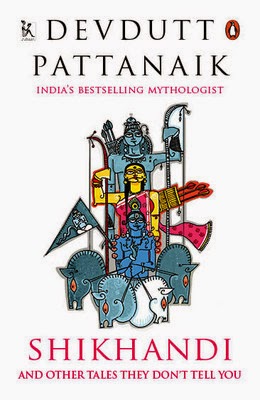
Book Review #36: Shikhandi and Other Tales They Don't Tell You By Devdutt Pattanaik

This is short and very informative book on the most infamous QUEERNESS ideology in India and other parts of the world. He has researched every nook and corner for the queerish tales from the epics of Hindus and several queer examples from the Greek, Egypt and China as well.

This book is an important book for India and Indians considering the LGBT community is not getting enough support from the government for their recognition in the mainstream world. To add ghee to the fire, Our Indian supreme court has ruled out a judgement an year ago which was against the LGBT community. So, these people became criminals and outlaws overnight. Author Devdutt has written an excellent piece of information that serves as a befitting reply to all those moral policing morons that roam around in the country in the name of culture and tradition.

This book is just about 170 odd pages covering close to 30 short stories of queer people from the Puranas, Vedas and epics such as the Mahabharata, Ramayana, etc.. Devdutt also established the context of "Queerness" from the global mythological sphere bringing stories from Vikings, Egyptian Gods, Chinese legends, Bibliographic readings, etc..


In the first half of the book Devdutt explains the pretext behind this "Queerness" and its origins from various places around the world. Later in the 2nd half, there are 30 stories that was available from the Mahabharata, Ramayana, Puranas, Vedas, from even the gods, etc..

Having read his previous books JayaThe Pregnant King and Sita, I was aware of most of the "QUEER" stories that he has captured in this book. Especially the story of Yuvanashva from The Pregnant King is a fantastic one. Also, I was well accustomed to the stories of Shikhandi, Mohini, Brihannala, Ardhanareeshwara, etc.. I am glad that I came to know about many other queer characters such as Chudala, Gopeshwara, Aravan, Sudyumna, Makara, Samaran, Alli, Pramila, Samba, etc.. The fascinating tales of Narada the messenger forgets that he was a man, God Krishna is a cross-dresser and most of all, Rama when he was leaving for his 14 years of exile, he informs his fellow citizens to head back to the kingdom and wait for his arrival, but addresses them as "All you men and women of my kingdom, please go back to Ayodhya and wait for my arrival", and Rama forgets to address the Queer people who didn't go back but stayed on the banks of the river. Hence, all these people of Queer nature wait for the arrival of Rama at the same river shore where Rama had left 14 years earlier!!.

These are amazing tales that proves time and again that Queerness is not a crime and it is existed since time immemorial. Author has added an excellent note from the vedas at the end of the book which says "Vikruti Evam Prakruti" that can be translated as "Queerness too is a part of nature".

My Rating:
4/5

Thursday, August 14, 2014

Book Review #27: Sita - An Illustrated Retelling of the Ramayana By Devdutt Pattanaik

This is yet another good book by my favorite mythological author Devdutt Pattanaik. We might have heard many versions of Ramayana's till today from our parents, teachers, grandparents, friends, colleague, etc.. But, this book stands class apart. This book tries to give us the various details of Ramayana not only a regular Valmiki Ramayana as in practice, but various versions of Ramayana that have been foretold around the world. It even includes the plays and folklore tales through which Ramayana has been passed on from generations to generations.

As I finished reading the book. Not only many of my questions have been answered. But also, many of the misconceptions have also been demystified. It is certainly a well researched book.

I am not going to give you all a regular review of the Ramayana. As most of us know the overall story, at least the overall Ramayana happenings. Instead, I will mention only those things, which I found worth to be noted in my review.

Sita:
First and foremost, the character Sita. She is one of the main protagonists of Ramayana. Is that enough to be known.? Certainly not. This book gives us the various traits of Sita and her tryst with the entire Ramayana. She is a well educated, well versed woman, full of wisdom, love and courage. She assesses the situation from her own point of view. We all admonish Rama as a bad person when he sent out Sita to the woods after their 14 years of exile, by questioning her chastity. But, in this book, Sita assesses her situation from Rama's point of view and she was happy to go!!. She tries to reason with her situation and comes to a conclusion. At sometimes you may feel, Sita is more mature than Rama in terms of actions, decisions and what not. I can say it aloud that, from this book, my respects for Sita has been multi folded.

Hanuman:
Another character worth to be noted is of Hanuman, the monkey god. He was the greatest devotee of Rama that mankind ever came to know. He actually teared down his chest to show the world that his lord, Sri Rama resides in his heart. But, that is not enough. He is full of knowledge and wisdom. He is a vedic scholar. The main section of the book, where Hanuman sets out to find Sita in Lanka. And, when he finds out Sita, the dialogues between them is a treat to read from the book. It is captured in such a fashion by the author that, you actually feel, this might have happened for real between Sita and Hanuman.


Hanuman the funny side: 
A funny incident which I would like to mention here. When Rama's 14 years of exile was over and they come back to Ayodhya. During Rama's coronation ceremony. Sita gifts Hanuman a pearl necklace for his help to fight Ravana. As Hanuman receives the necklace, he starts to bite every pearl and throw all the pearl one by one. Surprised Sita asks Hanuman why he was doing such things?. For which, Hanuman replied, "I was finding Rama in each of those pearls, and I threw it one by one after checking there was no Rama in it!!". This shows us that Hanuman's unconditional love for his master, lord, Sri Rama.

Hanuman the "generous":
It so happened after all the Ramayana tales that. Valmiki, supposed to be the original Ramayana writer was about to complete his writing of Ramayana. Then suddenly, a voice from the space told him that, Hanuman's version of Ramayana is better than yours. Saddened Valmiki thought no one will read his version of Ramayana. So he meets Hanuman and borrows Hanuman's version of Ramayana. To his astonishment, it was indeed a better version than his. So, Valmiki told Hanuman that, "Your version is way better than mine. And, no one will read my version of Ramayana". By hearing this, Hanuman tore down his version of Ramayana once and for all. Surprised Valmiki asks Hanuman, "Why you did that, your version was better than mine!!". Then, Hanuman replied "I wrote Ramayana because, I didn't want to forget my Rama and all those days I spent with him. You expect your version of Ramayana to reach to public, hence your Ramayana deserves to be saved than mine!!". This again shows us that, Hanuman is not just a mere monkey, but above all a generous, wisdomful person, who rose to be a godly figure.

Ravana:
When it comes to Ravana, there was no greater details in the book. As this book mainly focuses on Sita. Still, author had covered Ravana in greater detail and let his readers amuse by reading the knowledge and power that Ravana has possessed. The interesting section arrives when Ravana was shot by an arrow and he was about to leave his physical body. Rama asks Lakshmana to go and learn all the possible things from the greatest brahmana Ravana to gain his knowledge. When Lakshmana was not so welcomed by this idea. Rama himself will go to Ravana and lay down in front of him and asks him to educate him by his vast knowledge. This shows us that, even when you are fighting with your enemy, respect your enemy for his knowledge!!

Not only these tales that the author wrote, he also mentions the cycles of the Yugas and its a repeating phenomenon. Thereby, justifying his writing that, there may be thousands of Ramayana's that have happened in this never ending cycles of Yugas. As per the author, the 4 yugas (4 - Kritha Yuga), (3 - Treta Yuga), (2 - Dwapara Yuga) and the final one (1- Kali Yuga) that marks the end of the Yugas as proclaimed by Brahma. And this cycle repeats from Krita Yuga again. So, there are possibilities that, there may be many many Ramayana's happened that can't be imagined by humans.

This kind of surprising things are lot to find in this book. As a signature writing of Pattanaik, even in this book, he has produced some of the modern age practices that were directly linked to the practices that were followed in the Ramayana times. He also traces some of the modern places that can be directly or indirectly linked to the ancient Ramayana tales.

I would highly recommend this book to everyone. It surely helps you to gain and expand your knowledge on Ramayana.

My Rating:
5/5