Showing posts with label Book Revisit. Show all posts

Tuesday, January 31, 2017

Book Review #106: The Perfect Murder Collected and Compiled By Ruskin Bond

Title: The Perfect Murder
Collected & Authored by: Ruskin Bond
Publishers: Rupa Publications India
Genre: Thriller/Murder Mystery
Pages: 132 (Paperback)
Source: Advanced review copy from the publishers

Ruskin Bond, the name is enough to go and grab the book. The stories that he chooses or writes are pleasant always. Since my childhood, I’ve always been a big fan of Ruskin Bond. Being a thriller fan, I adore each and every story told by Ruskin Bond. It is always a special feeling to read his books.

The Perfect Murder is a short story in the book also the title of the book. The book also contains several short stories from various acclaimed authors like Arthur Conan Doyle, Wilkie Collins, Edgar Allen Poe and WW Jacobs. There is also a story written by Ruskin Bond. The book consists of eight different stories.

The very first story is the Perfect Murder, where two brothers Paul and Henry would wait for an opportunity to kill their aunt, so that they can inherit the property left by their uncle, but only on the condition that, the property would reach these brothers only after their aunt has passed away. Given the financial condition of the Paul and Henry, they were not in a position to wait that longer. Henry, a married man with four children, wasn’t able to meet the demands of his family, and he often finds himself borrowing money from his brother and his close friends. Whereas, Paul, unmarried, and wasted himself by drinking and roaming around. One fine day, Paul decides to meet his aunt and pretends to fall sick in her home. A generous, well behaved aunt takes Paul in and provides him the necessary food and medicines time to time. This hasn’t gone well with Henry and he decides to meet his brother Paul and take matters in to his hand. Paul agrees to his brother’s demands and asks him to get fine grained glass powder so that he can poison his aged fragile aunt. Henry does the needful and waits anxiously for the following day. But what followed is a shell shock experience for Henry, as he learns that, instead of his aunt, his brother Paul was found dead in his aunt’s house by consuming the glass mixed food. This story will surely keep the readers hooked to the book till it gets completed.

The other story which I liked and enjoyed is the Red Headed League by Arthur Conan Doyle. This particular story involves an investigation by the famous detective Sherlock Holmes and his doctor friend Watson. The story is epic in its own accord. The sharp observational skills of Sherlock Holmes and how he helped a distressed pawn broker who was cheated by his employer. The quick wit displayed by Holmes is a well known phenomenon of Arthur Conan Doyle. For sure, this is the story where you will be reading again and again to appreciate the intelligence of Sherlock Holmes.

One more story written by Ruskin Bond himself was about his uncle that murdered a person by poisoning. This story captures the ill motives of his uncle even after he got released from Jail. His uncle tried to poison Ruskin when he visited him. This story was repeated in Ruskin Bond’s other collected stories in other books. But, quite a good story to read.

This book is a nice collection of the light thriller genre stories. The book is an easy read and you can finish reading this in a few hours or a day to the most. You will certainly appreciate the taste of Ruskin Bond that made this collection of some of the interesting stories in this book. Though it is not a recommending read, but to re-live your childhood by reading some epic stories collected and penned by Ruskin Bond.

My Rating:
4/5


Note: I received this book from the Publishers in exchange for an unbiased review.

Wednesday, January 25, 2017

Book Review #105: Himalayan Blunder - The Angry Truth about India’s Most Crushing Military Disaster By Brigadier John Parashuram Dalvi Translated By Ravi Belegere

Title: Himalayan Blunder: The Angry Truth about India’s Most Crushing Military Disaster
Author: Brigadier John Parashuram Dalvi
Translator: Ravi Belegere
Publishers: Bhavana Prakashana
Genre: Military History/War
Pages: 500+ (Original Version) – 198 (Translated Version - Paperback)
Source: Personal Copy

This is the most chilling and humiliating account of India’s war with China in the year 1962. Famously known as Indo-Sino war or Battle of Thagla. Author Brigadier John P. Dalvi was the person who led his 7 Infantry brigade in defending the lands of India and eventually became the war prisoner of China. This book documents the anguish of a war hero that was treated lesser than a human being by the political leadership of India during 1962-63.

As per Dalvi’s account we get to read the most disturbing aspects of the dire military conditions of the India during that time. A belligerent army like India, though totally unprepared, has been ordered to throw the Chinese army out of the borders which India claimed was within the Indian boundary. The Chinese launched a devastating strike against India and occupied most of the territories and pushed back the Indian army within no time. Dalvi was an upstanding officer in the Indian army was firmly believed that China does not have any right over Tibet and that the McMahon line ought to be India’s north east frontier.

It was October 20, 1959, when Havaldar Karam Singh and his 20 strong troops doing their routine border patrolling when all of a sudden nine men from the patrol team were buried under in a matter of seconds in a hailstorm of bullets. Karam singh was taken as a war prisoner. This was the beginning of the Chinese aggression for the very first time; post their war with the Korea. Though it needed time to prepare for the war with India to claim few land areas, it was pushing all its limits to wage a fully fledged war against India. Whereas Nehru, the then Prime Minister of India was preaching the peace to the world.

The then Army chief Genreal Thimmayya’s fear about China stood confirmed. When he confronted the political leadership of the India and demanded the modernization of the army, V.K. Menon, the then Defense Minister of India plainly denied the request and asserted the problem with his own accord. He defended himself by saying; Pakistan is the “Number One” enemy of India and not China. General Thimmayya was amused and disturbed at the defense minister’s remark. Being an upright officer, he said what was bothering him...

“I understand our defense minister’s perspective. I have high regards for his abilities. But, I am aggrieved by his foolishness. One doesn’t rank his enemies as first, second and third. Perhaps, it is done in the communist countries and politics; as an Army Chief, I do not rank my enemies”

I will not be including the blow by blow account of Dalvi in this review. People can read this book. But wait… this book was shamelessly banned in the year 1969. Though there may be copies available in few numbers, what I read is the translated version of this book, penned by Ravi Belegere, a Kannada journalist and author.

Certain section from the book was really interesting to read. Dalvi’s description of the Battle of Tseng Jong, which took place 10 days before the Chinese assault on the Thag La. General Brij Mohan Kaul or B.M. Kaul had ordered 2 Rajput to move up Tseng-Jong and occupy the Yamatso La peak, 16000 feet above the sea level in full Chinese view with no artillery support. Dalvi convinced Kaul to move a patrol of 9 Punjabi to find a suitable crossing place for the Rajputs and cover them from a position at Tseng-Jong.  

A patrol of 50 men led by Major Chaudhary advanced to Tseng Jong. On 10 October 1962, 600 Chinese troops attacked Major Chaudhry’s patrol. It was obvious that they could not hold on for long, though the second Chinese wave was also beaten back, mainly on account of enfilade fire on the assaulting Chinese from the Rajputs hurrying up to Yamatso La. Major Chaudhry asked Dalvi for mortar and machine gun fire as a cover so that they could extricate themselves. Dalvi refused to order the guns and mortars at Bridge 4 to open fire.
The reasons given by Dalvi for his decision are interesting, but I’ll not detail them here. Please read this historical treatise from the book and find out Dalvi’s reasons. Dalvi says that 

“I and I alone, and are responsible for the decision not to allow the mortars and machine guns to open up”. 

Quite unlike BM Kaul who, when things turned bad at Tseng Jong told Dalvi,

“Oh My God! You’re right. China has prepared itself for a full-scale war. It’s each man for him from now on. You’re in charge of your Brigade. This is not in my reach. Only a Brigadier can execute this kind of war. This is your battle.”

And he turned and left, leaving Dalvi to helplessly watch the massacre of the whole platoon. Dalvi records several such incidents where a grossly under prepared Indian army faced the Chinese who were superior to them in every aspect. A most telling instance is

“…. a soldier saluted me as I stepped into the bunker and said, “Sahib, look there! The enemy is on the opposite slope. They’re burning firewood to beat the cold.” I felt a slap of humiliation. This was one of the rare instances this happened in thousands of wars throughout history. Burning a fire at night is a sure invitation for the enemy to attack. But then, this enemy on the slopes of the Thagla Mountain was confident: both of his strength and our sorry state. He knew for certain that we would not attack: we could not.”
In his final journey, he pays homage to every person right from foot soldiers, majors, lance naiks, singnallers, doctors, brigadiers, commanders, his assistant staff, etc… who died defending the indefensible.

“The Chinese used the same war strategies in vogue for centuries but…. their guns were more modern, and their clothes were warmer than ours…. out there, away from the warm world, the October chill doesn’t descend from the skies; it climbs from the depths of the spinal cord. All our men had to wear were cotton clothes suited for summer, shoes which slide on snow… the only colour my men could see was the ash-white colour of death. A flash of sunlight was enough to blind them. This blindness caused several men to walk directly into the waiting arms of the enemy. My request for snow glasses was granted, all right, but when they arrived, the air-dropped bag dropped somewhere in the abyss-like crevices…and those snow glasses were broken into pieces which were not in a condition to wear. My soldiers were left to gaze those glassy snow with their bare eyes and went blind. During those times, without even realizing, my soldiers has walked into the enemy camps”

One must read this book to understand the shamelessness of the Nehru’s government, that failed to supply even the basic necessities like food, water, better clothing, shoes, goggles leave alone the artillery and ammunition. Towards the end, Dalvi and his remaining men went without food for more than 3 days. Without even having a map of route, they walked straight in to the camp that was wholly surrounded by the Chinese troops.

“We descended the Dhola Mountain after the Chinese disappeared from sight. We gave up the final hope of even sighting a small tukdi (regiment) of our men. I descended rapidly out of a sheer will to live. The slope ended in a forest…the path was even tougher to navigate. Meanwhile, I had lost four of the eleven men following me. I reached a clearing, which then led to a small mud road. It was all over.”

Finally John P. Dalvi was captured by the Chinese army on October 22 1962, at 9.22 AM. He remained as a prisoner of war from October 22 1962 till May 1963. The book doesn’t record the event of what happened during Dalvi’s stay at the prisoner camp during those days. I guess this was carefully censored before release of the book. Anyways, the book itself was banned in 1969.

“We landed in Dum Dum airport in Calcutta on May 4 1963. We were received cordially, appropriately. But the silence there was disquieting. I realized later. We had to prove we weren’t brainwashed by Chinese ideology. We had to prove we were still loyal to India. My own army maintained a suspicious distance. The irony cannot be harsher: this treatment from a country, which for more than a decade had brainwashed itself into holding the Chinese baton wherever it went.”

Himalayan Blunder has simply proven its contemporary relevance in the sense of history repeating itself: notice today’s Chinese cheerleaders who occupy disproportionate clout in the UPA government. By the way, the Battle of Thagla began on October 20, 1962 and lasted just over 3 hours, between 5 A.M and 8 A.M. An entire brigade was massacred. The history will never forgive Nehru and his coterie that paved the way for the most humiliating military disaster of Indian history.

My Rating:
5/5

Monday, January 23, 2017

Book Review #104: Uttarakanda By Dr. S.L. Bhyrappa

Title: Uttarakanda
Author: Dr. S.L. Bhyrappa
Publishers: Sahitya Bhandara
Genre: Mythology/General Fiction
Pages: 350+ (Hardbound)
Source: Personal Copy

We all grew up by reading and listening to the stories of the Hindu epics like Ramayana and Mahabharata. We have a sculpted belief that a certain character from certain epic will behave like this and there won’t be any misconduct or any character deviation from their original ones. At times, these beliefs can be shaken to the ground when you come across certain books. At the same time, certain books make you question the reality. This is the very essence of the book “Uttarakhanda” penned by my favorite author, philosopher and a great human being, Dr. S.L. Bhyrappa. He finished writing this book in just 3 months of duration, but took whole 8 months to re-draft each and every chapter before sending it for the publishers. That’s typical SL Bhyrappa’s flavor.

Coming to Uttarakanda, this is the retelling of the Ramayana. But what makes it different from other writers is the theme of the book. This Ramayana is entirely from the viewpoint of Sita. How she sees the entire Ramayana as an event? What was her thought process when she decides to accompany Rama to the exile for 14 years? What were her thoughts when Ravana abducted her from the forest? Etc… The entire narration belongs to Sita in this book. How she endured all those years along with Rama and his brother Lakshmana is pictured vividly, brilliantly. This is one of the hearts wrenching narration of the Ramayana I’ve come across in my entire life.

One thing I must mention in this review, there are no gods in this version of Ramayana. Each and every character is human. Rama is as much of a human as a normal court maid. There are no flying chariots, no 10 headed Ravana but one, no curses, no divine arrows, and Hanuman is a normal 50 year old person, who believes that he belongs to the clan of the Lord Hanuman. I must applaud the brilliance of the author here for keeping the Gods as gods and making this story that touches the nerve of his readers.

As the story progresses further, we get to read the normal tale of how Rama and Lakshmana accompanied sage Vishwamitra to kill couple of rakshasas and eventually reaching the Kingdom of King Janaka, the Mithila, and breaking the Shiva’s bow to win the bride Sita. But a little twist here from the author makes it even more human. The actual plot of breaking the bow, was a setup by the King Janaka who was under the impression that, if any prince would tie the bow string with their bare hands would win over Sita, so that, the actual birth details of Sita would be negligible, since she was won in a challenge!! It is just brilliant to have this thought. It makes us to ponder for a few minutes. The after events keep Rama in high regard. Dasharatha actually learns that Sita is not the biological daughter of Janaka and she was actually found in a land while tilling. He raises an objection to the marriage and decides to cancel the wedding. By the timely intervention of Rama, this was avoided and Rama marries Sita, so does his brothers and Sita’s younger sisters.

The plot carries further in a regular manner but with a humane touch. The promises that Dasharatha made to his 3rd wife Kaikeyi has been written in an entirely different perspective which I am not going to include in this review. This must be savored from the book. One thing the readers must keep in mind that, Rama was a staunch follower of Dharma even in this version. He learns the ill motives of Kaikeyi and decides not to become Prince. As per Kaikeyi’s wishes, Rama prepares to leave Ayodhya to the exile for 14 years. The event after that takes an entirely different approach where the human nature of Rama, Lakshmana and Sita will begin to unfold.

Now the real story of how Sita tries to analyze Rama and Lakshmana and herself begins slowly. Soon she realizes that it is difficult to adjust to the forest life. Also, she learns that without Lakshmana’s assistance, she and Rama both wouldn’t have been survived in that forest. Rama was a recluse in the forest life. He was enjoying the nature with a least concern to check on his wife and her comforts.

The climax of the book will keep your mind occupied and haunts you like anything. Ravana will abduct Sita, but not by himself. He sends his troops across the sea border to bring Sita via boat. His men will do just that by tying Sita to a boat and rowing across the sea. Ravana abducts Sita for the sole intention of avenging his sister Surpanakhi who got insulted by Lakshmana. Surpanakhi instigates Ravana by narrating the events that took place when she confronted Rama and Lakshmana in the forest. She describes Sita as a beautiful lady and he should abduct her at any cost and rape her. Being a womanizer, Ravana was all prepared to get Sita to his city of Lanka. Once after the abduction, the scene was written in an entirely different fashion, where Sita confronts Ravana and asks him to win the battle over Rama. If he wins, then he can marry her. But Sita was all prepared to immolate herself if the unthinkable happens.

Once the battle was over, the real test for Sita begins when Rama doubted Sita’s chastity. He wasn’t sure whether Sita was raped by Rama or not (sic). Having spent more than a year in another man’s supervision, Rama doubted whether to take back Sita or not. This is an eye opener scene for the reader. When Sita questions the same thing to Rama about his chastity for spending more than a year away from her, Rama didn’t have any answers. Sita’s questions are a mirror test to the present society. Is chastity applicable only to women? Who made this rule? Won’t men also fall under this category? Why women are termed as spoiled when she was raped or abused? Why the same things do not apply to men? Are men not under the purview of rape? Won’t they get raped by women? All these questions of Sita hits the bulls eye to the present society that questions that chastity of a woman or term her as raped when it wasn’t her fault? Rama’s unwillingness to answer these questions denotes the situation of every man in the present society.

The final confrontation of Sita with her husband Rama was a true testimonial of how bad the decisions that Rama took against Sita. When she confronts Rama asking him about his conduct with sage Gautama, asking him to forgive his wife Ahalya when she committed adultery 25 years back, and why he can’t he do the same? When Rama can bow down before a low born woman Shabari and consider herself as his mother, why he went ahead and beheaded a low born man who was doing tapas and reciting Vedas? Rama’s reason was like low born persons shouldn’t do the tasks that belong to the higher born persons. What kind of Dharma he is following? For all these things, Rama was not able to answer anything.

Overall I believe that book showcases the patriarchal society of Rama’s era and why it hasn’t changed even a bit in the 21st century today. Questioning a woman on her every move is still prevalent in the current society. Rama was no exception either. He just behaved the way he believed it was according to the Dharmic principles. He didn’t even shown the human side of him to the world. Though we revere and celebrate his life and keep him in high regard as the epitome of the justice, but how he wronged Sita will remain as a black mark on him till the earth survives. A must read book. You can go back to the earlier writing flavor of S.L. Bhyrappa. I would definitely rate this book beyond 5 stars and recommend it to every reader.

My Rating:
5/5

Wednesday, January 4, 2017

Book Review #102: Think With Me: Fundamentals for making our country ideal By "Saharasri" Subrata Roy Sahara

Title: Think With Me: Fundamentals for making our country ideal
Author: “Saharasri” Subrata Roy Sahara
Publishers: Rupa Publications India
Genre: Non-Fiction
Pages: 150 (Paperback)
Source: Advanced review copy from Publishers

Subrata Roy Sahara is a self made billionaire. Whatever may be the adverse transactions or financial hiccups he might have faced that eventually landed him in jail. But, that didn’t deter him to pen down his thoughts about the country and the ways it can be made better for the future generations. This book is a sequel to his other books “Thoughts from Thihar” & “Life Mantras”.

In this book Roy has argued some of the pressing issues that India as a nation is facing in each and every day.  He has penned down his idea of how we can tackle those problems in a more mature way and including every stakeholders at present. Though some ideas seem out of the box and some may feel it is ridiculous, but one has to appreciate the thoughts that have been put forward in this book.

The book has many ideas pertaining to many current problems. Especially his ideas about the exploding Indian population that is a sure shot threat in the future. Quoting the example of China’s one child policy, Roy has asked the government to take up the stand and device only two children policy for Indians. He has also put forward his ideas of giving financial perks to those families that will stick to the two children policy. The idea may seem plausible if we look at the present problems we have due to over population. Still over 30% of India’s youth are unemployed. Quality of life is deteriorating day by day. Children are suffering from malnutrition. Equal opportunity seems distant possible because the system cannot accommodate each and every individual with a nice living and earning. As a personal opinion, honestly, I feel the idea should and must be implemented.

As we read through the book, Roy has suggested some improvements in the electoral process that we already have been practicing over 50 years. Author suggests that an MP (Member of Parliament) be selected outside the election purview and they should be able to monitor the works and progress of an elected MP. He has to report to the Prime Minister periodically with the stats and figures of n MP’s works. If the report seems to show that an MP has failed in delivering his promises to his people, then he can be sacked immediately. Though this idea seems to be a nice one, but implementing this will be an add-on task on the government exchequer. There are able government bodies and agencies that can keep track of an individual portfolio’s progress and recommend improvements.

At the last part of the book, Roy talks about the role of media, the fourth pillar of our constitution. These days’, the media’s role has been largely opinion oriented than the facts driven. Print and Visual media both are in a rat race to deliver fast new to their viewers and readers, that makes them to deliver news without checking the facts and relevance. As per the author’s suggestion, he recommends the government to curb the media and put forth a stringent guidelines and recommendations in terms of delivering the authentic news. There are lots of people who are persecuted due to the false propaganda of media. He suggests to setup fast track courts in dealing with the media’s propagandist nature. These courts should be able to deliver justice quickly and make the media to behave in a more responsible way. Through this even lawyers would get employment and many of other staff members. Given the context that author has come up with this idea, I see that he has been a personal victim of the false media propagation. Anyway, there are courts to decide whether Subrata Roy was indeed innocent and was actually framed by the media. I really liked this particular idea. It should be the need of the hour to control the mainstream media in a country like India. People are constantly fed with the false stories, propaganda news, malicious content, inappropriate allegations, and so on.

Overall, I feel this is a nice book. The ideas and thoughts mentioned by the author was really an eye opener. The very impressive idea that made me to think for over few minutes was to have a national religion for India. Does that really work? We have no idea. But, author’s urge to have a national religion for a diversified country like India seems too unconventional. Never in the wildest dreams of any Indians, would this become a reality. Even though majority of the country are wishing to see it happen in near future. This book is not a recommending material, but to read once is not a crime.

My Rating:
3/5

Note: This book was given to me by the Publishers in exchange for an unbiased review.

Monday, December 26, 2016

Book Review #101: Crooked Minds - Creating an Innovative Society By Kiran Karnik

Title: Crooked Minds – Creating an Innovative Society
Author: Kiran Karnik
Publishers: Rupa Publications India
Genre: Innovation Ideas/Society and Social Science
Pages: 220 (Hardbound)
Source: Advanced review copy from Publishers

What it takes to being innovative or inventive? What are the roles that an individual, society, organizations, governments, cities, states and countries play in building those sustainable models? What are the pros and cons of doing the same? What are the parameters that one should and must consider while innovating? How those markets can be capitalized? These are some of the questions that any entrepreneur will face in their lifetime while they’re trying to establish a new venture of their own.

This is a book that speaks about those challenges of setting up an innovative culture in any aspects and in any scale. Be it an individual contributor or a team, each one of them can gain a good insight from this book on how to take a step ahead. Innovation is something that requires out of the box thinking in each and everything that a person or an organization does. But, what are the pitfalls or lessons that one needs to incorporate in dealing with such aspirations? This book specifically deals with that ideas where the entrepreneurs can get a new perspective altogether.

The book has various sections covering wide range of topics which deals with the innovation. Author Kiran Karnik, a man of many credentials, has crafted a well researched and thought off book that could create an interest among individuals who can take up the role of entrepreneurs. The author emphasizes the fact that exploiting and capitalizing the Indian innovation market (popularly called as “Jugaad” market) and tap into those areas which is not yet been given full research and importance. He has given numerous examples of companies from Indian and international arena. 

One such example is the organization called “Zip Dial” a venture setup by a foreigner in Bangalore which purely exploited the Indian invention of “Missed Call” concept and started out a huge organization based on this very comical idea. Zip Dial has assigned a specific number to their clients where customers can give missed calls to it and immediately the customer would receive the required information regarding that product or services at no cost. This is purely a win-win situation for both customer and the company. This was proven a game changer for the company Zip Dial, and they went on to add nearly 500 clients as their customers in few years of starting it up. Zip Dial was acquired by Twitter recently.

Further reading into the book, we will also get to read stories of the startups, now big companies like Uber, Netflix, and Airbnb. These companies have had their basic idea of exploiting the untapped markets and created a niche out of it. Now, Uber has definitely changed the concept of how the customer will book a taxi service and how Airbnb has asked the users to become hosts for strangers in their country by sharing their accommodation for a nominal fees setup by the customer themselves.

The book also covers some of the important aspects regarding the logistics considerations while setting up the new company. From the Indian perspective, author has carefully probed and analyzed the major metro cities and the advantages and disadvantages that it provides to support a new venture. He has eloquently explained about cities like Bangalore, Mumbai, Delhi/NCR, Hyderabad, Chennai, and Kolkata and so on. He also emphasized the 2nd tier cities like Ahmadabad, Cochin, Surat, Pune, etc…

Author also expressed his concern regarding the government policies that are available in promoting the innovation and startup cultures in the country. Also, he has suggested the new entrepreneurs to reach out to specific government bodies to avail the facilities and funding for their startups. This includes from various fields and not only IT sector.

The author has made some good amount of research on the standings of India on a global startup scale. India’s ranking in the yearly patent filing category. How India is faring low compared to USA and China in filing and procuring the patent rights for their unique designs and concepts. He has explained the importance of obtaining the patents to inculcate the habits of safeguarding the intellectual property rights of an individual and organizations.

The book also stresses about the need of the high quality university requirements for our country. How a globally recognized institutes would result in fostering a startup culture and why India is basically lacking these kind of infrastructure. For sure, India is struggling with old syllabus in our technical universities and is not keeping up with the pace of the changing world. The book has a clear explanation of the importance of higher; advanced technical education. This is the need of the hour if we want our younger generation to compete with others globally to make a mark in the startup initiatives and making them a success.

Overall a must read book for all those aspiring entrepreneurs. This will give you a fair idea of how competitive this world has become in terms of setting up new ventures. I would definitely recommend the readers to buy this book.

My Rating:
5/5

Note: This book was given to me by the Publishers in exchange for an unbiased review.


Monday, December 19, 2016

Book Review #100: Chanakya in Daily Life By Radhakrishnan Pillai

Title: Chanakya in Daily Life
Author: Radhakrishnan Pillai
Publishers: Rupa Publications India
Genre: Life Lessons/Motivational/Non-Fiction
Pages: 272 (Paperback)
Source: Advanced Review Copy from Publishers

Life is all about doing the right things in the right way. As the old adage puts it out “Knowledge is knowing a tomato is a fruit; Wisdom is not putting it into a fruit salad”. There is a clear idea of what to learn and what not to learn from vast amount of sources. But, what if you find everything in a book that is combined as a one stop solution for all those life lessons? The book “Chanakya in Daily Life” by Radhakrishnan Pillai would fill that gap. This book is all about differentiating between what is right and how to tread that path.

The blurb at the back cover of the book says “Life is unpredictable and full of challenges. One wrong step and everything can come crashing down. In such a scenario, one often wishes for a roadmap of life, but how is that possible?”

This book is a clear roadmap for all your doubts and worries ranging from personal, professional and family life. Taking example of an Indian guru, Chanakya and his ever popular work Arthashastra, author has come up with a book that can be read every day and for lifetime too. The book is broadly and rightly classified in to three different sections. The first part deals with the individual life and lesson that can be learnt and adopted in one’s personal life. The second part of the book deals with the professional life that teaches what one must do in their professional life. The third and final part of the book teaches the importance of a family life. Each part holds its importance and is equally connected to the other two. One cannot have a sounding personal life, but lacking professional or family life satisfaction. It is interdependent on each other and this book explains the best way of handling all these things diligently and in a profound way.

In the first part of the book, the author discusses the personal life of an individual. The ideas ranges from waking up at a certain time every day, daily ritual, exercise for the body and the mind, relaxation, developing tastes in music, inculcating the habit of reading, having a hobby that could become a profession one day, sleep duration, breaking and planning the day into productive hours, imparting the knowledge of astrology and up to what extent one can believe in  astrology, practicing meditation, food habits, financial goals, creative hobby, finding a guru, having a personal philosophy, etc.. Each chapter holds a valid point and a direction in which one can master these habits. Each chapter is explained by keeping a reference of Chanakya’s Arthashastra.

In the second part of the book, author discusses the professional aspects of an individual. This part mainly focuses on how one should behave and adopt a disciplined professional life. Author has discussed topics ranging from going to the workplace, pondering over the day to day task, preparing for the day in advance, developing the interpersonal skills, handling the team member and co-workers that has different mindset and thinking capacity than yourself, training people, daily documentation of work, developing the contacts in a working place, how to give a recognition for your sub-ordinate, what one must follow while appointing a manager, what one should do in case of work related travel and how one can adopt these leisure hours to productivity, how to plan for daily, weekly, monthly and yearly review meetings, and finally how one should plan for their retirement in advance. These lessons for sure are relevant even today. As per Chanakya’s reference in Arthashastra, each and individual lesson explained in this chapter would make a king wise and assertive in the long run. So does a common man when he adapts a tiny bit from these sections in to his personal life.

The final part of the book deals with the family life and its importance for an individual and how it is connected to the personal and professional life. The author discusses various facets of one’s family life and how Chanakya has prophesied in this Arthashastra regarding a King’s family life and how it is still relevant in present world scenario. This chapter begins with the duties of the householder and what best one can offer to his family at his abilities. What is the purpose of marriage and how one should treat his spouse, what are the advantages and disadvantages of sex that can impact a family life of a person, how one should take care of his family and provide basic necessities for his dependents.  How to educate their children, what is the best way to bring up their children, the power of family prayer. What are the lessons one can learn for being a good parent, why imparting the concept of charity to children should be encouraged, and how to give personal individual space for each family members. This part ends on a chapter of how to feel gratitude for whatever things we have obtained in this life from their family.

Overall, this book is not a regular one time read it and forget it affair. This book can be read again and again. You can start in any chapter and it still makes profound sense. A book that can be considered as a package of life lessons in all three important aspects of a human life. I would encourage readers to buy this book. This is definitely a collectible stuff.

Few famous Chanakya’s quote that are used in this book:

-       Education is the best friend. An educated person is respected everywhere. Education beats the beauty and the youth.
-       There is some self interest in every friendship. There is no friendship without self interest. This is bitter truth.
-       As soon as the fear approaches, attack and destroy it.
-       Once you start working on something, don’t be afraid of failure and don’t abandon it. People who work sincerely are the happiest.
-       Learn from the mistake of others, you can’t live long enough to make them all by yourselves.


My Rating:
5/5


Note: This book was given to me by the Publishers in exchange for an unbiased review.

Tuesday, September 30, 2014

Book Review #38 - Who Will Cry, When You Die? By Robin Sharma

I generally don't read self-help books. But, this one book made me to read more of such books. Thanks to the author Robin Sharma. It didn't really transform my life in overnight, rather, it did allowed me to sit and introspect a bit on what I might be missing in life. This book is something that reverberates in your mind for a long time, leave alone giving you an idea of what's most important.

I really loved the title of the book. In a moment you all want to read this book. Who Will Cry When You Die?. A question that everyone must ask themselves when they are alone and contemplating about life and its oddities. Robin Sharma had clearly articulated in this book, the 101 'Life Principles'. Is it just 101 or much more? To answer this, there are more to what Robin Sharma had tried to give to his readers.

The entire book is just about those small changes that we can apply to our lives to bring that happiness that we always longed to bring or see. Collection of these thoughts what makes this book as an unique and inspiring. You may wonder while reading this book, why didn't I realized these trivial things all these days? Well, we are too much deep in our materialistic desires and never in any given day has given thoughts about these.

This book is just about realizing what makes us more happy and less resentful. Robin Sharma had explained in a simple but elegant manner. Author had covered every little details ranging from waking up early in the morning, to have a nice family outing, to have a collection of our favorite books, to see that one life changing movie or to have a gala time with our kids till some of the serious topics like why doing meditation is a good way of silencing our chattering minds, why having a "lone time" is important, why should we start living our day like its our last etc, etc...

We all knew that these things are more important in our life, but, we haven't given a much thought about it. From this book, what you learn is an art of living and an art of dying as well. We are living our life trying to achieve something we don't really like to show off to some people whom we really like. If those people like you really, they allow yourself to get something that makes you live as yourself. Though I don't really say that, materialistic success is not required, I am only asking to not consider those as the real success. There is something beyond in everyone's life that we are failing to appreciate. Well, this book just gives you an idea of finding those somethings and make your life more meaningful.

Robin Sharma regularly uses famous quotes in all his books. That adds more meaningful messages to what he says. Even in this book you find ample number of quotes that adds more color to the book. I really liked this particular quote:

"When you are born the World rejoice while you cry. Live a life in a such a way that when you DIE, the World should cry and you rejoice" - Sanskrit Saying

I recommend this book to be read by everyone. Though it may not bring overnight changes to your life, but, surely, it evokes some questions that every readers can questions themselves.

My Rating:
5/5

Saturday, August 2, 2014

Book Review #25: Tantu By Dr. S.L. Bhyrappa

Yet again, I am here to give you all a review of Dr. S. L. Bhyrappa Sir's another magnificent novel Tantu. Tantu can be meant as "Links" or a much sophisticated close meaning as "Relations". This book reveals the various facets of a life and how the bad decisions can affect one's own life and their surroundings. I can say, this book is more or less similar to Anchu in terms of the characters, feelings and relationships are concerned. But still, it makes altogether a different impact on its readers. Much have been talked about the capabilities of Dr. SLB sir and his magic while creating a psychological view of every character.

Tantu is a journey of individual souls that judge things from their own perspective. The protagonists are mere mirror image of a modern society. The reality is, Tantu captures the minute details of a person that you and me see in everyday of our life. This book is a fight between, honesty, bravery, cunningness, illicit relations, upbringing kids in the right way, money, meditation, music, school, government, politics, politicians, journalism, etc, etc..

Spread across 900 pages. This book captures many stories that are interlinked with each other. Author had brilliantly connected each story to the next and previous one in order to achieve the full effect. A complete package of a typical Indian life in a typical India during the time of Indira (the then prime minister of India)!!!.

There is no single protagnonist in this novel. Each character has the same depth of a protagonist range. A Resident Editor of a popular english daily Mr. Ravindra, who sticks to his principles and known for his honesty and integrity. A shrewed woman, wife of the resident editor, Mrs. Kanti, who is least cared about living the life in a right way, she rather believed in living life in all possible way. And, a teenage son of this couple Anoop, who falls in the wrong companionship of wealthy kids, and starts to steal things from his school, steals money from his dad's pocket. Later stage of the novel witnesses Anoop being convicted by police, when raiding a brothel cum nude dance bar.

The story revolves around these main characters. But, the other events and stages of the novel feels as important as these 3 peoples. As the novel further goes, Mr. Ravindra came to know that, his son is going in a wrong direction. He decides to get him admitted to a different school, that runs on the principles laid down by Mahatma Gandhi. The speciality of this school is, it doesn't take any support from the governmental agencies, even, the teachers are mostly celibate and they stays in school forever. The vivid description of this school must be read from the novel itself. Here author introduces us to the scene, where Mrs. Kanti was not at all happy about getting her son admitted to a school in a faraway village. This event had led her to have a spat with Ravindra.

As the novel further goes, Mrs. Kanti decides to go to her hometown for her father's birthday. But, she decides to stay there forever. Reason being, she meets one of her childhood friend, Mrs. Sheetal, who works in external ministry department. She gives Kanti an idea of starting her own cloth export business, for which, Kanti agreed instantaneously. Later events, proved that Kanti grown as one of the successfull business tycoon.

The real twist in the novel appears now. In Anoop's school there is a music teacher by the name of Mr. Hemanth Honnatti, that left his high paying job and decides to pursue his career in sitar music and runs away from his house and was practising in Anoop's school. Fortunately, Kanti knew the parents of Hemanth, she decides to meet him and persuade him to go and meet his parents. As the events unfolds, Kanti realizes that, she is attracted to Hemanth, she slowly shows her intersts in him, for which, Hemanth reciprocates equally. Within no time, their relationship had grown beyond imagine and they started seeing each other almost daily.

As the novel approaches towards the end. Anoop had joined an engineering college to pursue his engineering. Here author tries to explain the grave realities of the problems of a young adult, who is curious enough to try his hands at relationships, but not adult enough to sustain those realtions. Anoop tries his luck with many female students from his college. He also visits brothels, that leads to him in a bigger mess in the later stage of the novel. Finally, he decides to pursue his career in USA for an administration degree in Business. Here, due to Indira Gandhi's emergency declarations in the country, Ravindra decides to quit his resident editor job as he feels that there is not enough room left for fair, honest practice for journalism. His newspaper investors asked him to not to cover any governmental decisions and to stay out of reporting those things. This was the phase, that whole of India was in ultimate shock by witnessing the dictator style of governance from Indira Gandhi.

In climax, Ravindra will come to know about the illicit relationship that his wife Kanti had with Hemanth. He tries to question her, but he gets admonished from Kanti. Even Anoop knows about her mother's illicit relatioship, for which, his mother tactful response makes him silent. Here Kanti had grown out to be a good successfull business icon, but, failed as a wife and a mother. She had suffered a massive heart attack and passes away in isolation. Ravindra was put behind the bar for writing against the Indira Gandhi's government, Anoop marries his girlfriend and decides to stay in USA. The final scene marks, where Ravindra and few other were shouting slogans against the government for its decision to arrest common people. This marks the end of the book.

As though my review seems to be long and very simple. It's not the case, I didn't even revealed 20% of the novel in my review. It is such a huge novel, and it is difficult to write a conclusive review after all. It exposes those persons that lives in each one of us who are after material desires than relations and responsibilities. As we witness in this novel, Kanti failed as an honest wife and a loving mother. Anoop failed as an honest son, Hmeanth failed as a trusted friend, Ravindra failed for being an honest man!!. Their relationships or TANTU with each other seems to be just on the papers, and it has broken long ago.

We all must appreciate the hidden meaning in this novel. Don't just think it is a work of fiction, it gives all of us some lessons on how to maintain our relationships. If we go behind just material desires, our relationships, for sure, goes in a different direction. We wouldn't even realize it. By the time we realize, this TANTU or RELATIONSHIP will be beyond the stage of repair. A must read for everyone.

My Rating: 
5/5

Thursday, June 12, 2014

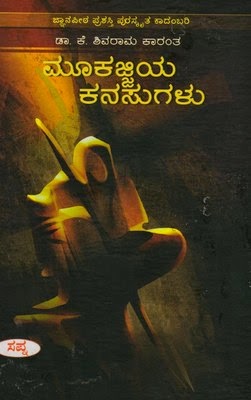
Book Review #16: Mookajjiya Kanasugalu By Dr. K. Shivaram Karanth

Every Indian who grew up watching some of the notable authors getting conferred with Jnanpith_Award sometime or the other. Usually, this award will be given to the authors for their notable literary works. The regular held notion of any of the Indian readers that, to win a prestigious award like Jnanpith, the author has to write a voluminous book that lasts hundreds and hundreds of pages. Well, I can't completely agree or disagree with that. The reason being, the book which I am reviewing in this post.

Dr. K. Shivaram Karanth, Kannada's renowned author was awarded with the Jnanpith for this book Mookajjiya_Kanasugalu in the year 1977. This book is just about 270+ pages, but, the quality of the writing and the plot of the novel is epic. Novel is very profound and thought provoking which actually makes the reader to question themselves about various basic questions of everyday life, like God, Culture, Belief, Sacred texts, Bhagawad Geeta, Death, Rebirth, Evolution etc, etc..

The title of the novel can be translated to english as "Grand Nanny's Dreams". The heroine of the novel is an 80 year old grandma named Mookambike who is the grandmother of Subraaya, the 2nd protagonist of the novel. Story which is set in a village called Mudur which is near to Shimoga district of Karnataka.

This book narrates the interaction of the grandma Mookajji and her grandson Subraaya about various subjects and situations. Subraaya poses various questions to his grandmother and through her response author tries to convey his ideas about the various topics in an easy and understandable way. Author's thought about the various subjects like God, Culture and other aspects is very elegant.

The journey takes the reader like a smooth wave of wind in every page and makes the reader to longe for more questions that Subraaya must ask his grandma. Readers will be so engrossed and wish even they must have such a grandma after all.!!. Though there are multiple characters in the book, the book mainly focuses on Subraaya and his questions for his grandmother and of course her answers. Subraaya is an educated man, but decides to stay in the village by looking after his land and farms. But his college degree in history makes him to learn more about history and he always believed that, his village Mudur has a long lasting history of more than 1000 years. He often tries to go into forests and caves around his village and collect some of the old artifacts and show it to his grandmother to know the details of those items. He always beleived that, his grandmother had special magical powers that, with just a touch of things, she can able to recall most of the history behind those artifacts. This special quality of Mookajji what attracted Subraaya, that made him to pose hundreds of questions everyday. At the same time, Mookajji is happy to answer all of his question in her own way which is the lucid part of the novel.

The best takeaway from the book is when Subraaya poses questions on God's existence and the answers given by granny Mookajji in her own way makes the reader to chuckle. Mookajji had her own belief and stories about Idol worship, Tantric experts, Jainism and Buddhism. According to the book, Mookajji was able to visualise many of the things as if it is happening in front of her eyes. These events made Subraaya to ask many questions and he enjoyed the various stories told by his granny.

Overall, going by the content and quality of the book and the simple way it was presented, I recommend every reader who is really eager to read yester year's kannada books, must read this awesome book. It has lots of comic incidents and more than that, it has food for thought for the readers. I will assure you that, the time you spent on reading this book will not go wasted. It increases your perception and gives you a new ray of light for looking the things that you have seen all these years, in a different way. The Jnanpith award for this book is greatly justified. Author had shown us the way, in which, even the most complex thoughts and ideas can be presented in a simple, understandable way.

My Rating: 5/5

Wednesday, June 11, 2014

Book Review #15: Chomana Dudi By Dr. K. Shivaram Karanth

There are few books which completely takes the readers into a trance and leaves them for several days. "Chomana Dudi (Choma's Drum)" is one of such books. With full of emotions and tragic sequences in the entire novel leaves the reader spellbound. This is one of the short stories written by Kannada's ace novelist, Jnanapith award winner Dr. K. Shivaram Karanth in 1933. This book entirely focuses on the untouchability practices that was rampant in India during that time. The main protagonist of the novel "Choma" is an untouchable or what we popularly call as "Dalit". 

This short book has been made into movie in the year 1975 under the same title directed by B.V. Karanth. This movie has won the Swarna Kamala award from president of India.

The practice of untouchability is not new to India, it is much worse than racism. Author has elegantly captured all these practices and given the shape of a journey of a man called "Choma" and his beloved "Dudi" or "Drum".

Choma is an untouchable bonded labour in a village. He and his entire family was working for a landlord in a village, as he was not allowed to own a land and till on his own. Due to the tag of a backward class, Choma was not allowed to till any land, which he has desired the most. Though he had acquired a pair of bullocks from a nearby forest, he wish of owning and tilling a land remained a dream after all. This has frustrated him for life long and to forget his sorrows and show his anger on the society he gets drunk every night and starts playing his Dudi or Drum.

Without much success with any of his landlord, Choma was contacted by some Christian missionaries who intimidated him to get converted to christianity by offering him a piece of land to till. Though choma was interested at the beginning, later he rejected that offer and felt proud of his faith and religion.

Choma has 4 sons and a daughter, 2 of his elder sons Guru and Chaniya who were working in a coffee estate far away to pay off the debt. Chaniya dies of Cholera and Guru converted to christianity and marries a christian girl and never visited his father ever again. Here, choma's daughter Belli, goes to the same coffee estate to pay off his debt, who falls prey for Manvela, the writer of coffee estate's owner. She was abused constantly and even the estate owner had raped her often and one day sends her off from the coffee estate saying the debt was cleared.

In Choma's village one bad day, his 2 younger sons were playing near the river and accidently one of his son slips into the river. Since, they were untouchables none of the other villagers couldn't come forward to help him to save his son. All these events had eventually made Choma to lose his senses. He lost his sense and was always staying at house without going to labour work and often playing his Dudi (Drum) in a deafening noise to forget his tragic fate. When he thought everything was over, he and his daughter Belli decides to join Guru, and accept christianity.

Choma decides to go and meet his son Guru, he leaves his village. When he was half-way, he changes his mind and decides whatever happens to him, he is not going to change his faith and religion. By deciding this, he heads back to his house, but, he saw an unexpected scene at his house. His daughter Belli was seen in a compromising position with Manvela, who was that writer of that coffee estate. Full of anger, Choma beats his daughter and throws her out of the house and he chases off his bullocks into the forest and comes home, locks himself inside the house and starts playing his Dudi or Drum non-stop till he breathes his last breath. This marks the end of the book.

Choma's dream of becoming a farmer and tilling his own land remained a dream after all. Throughout all his tragic fate of incidents, only his Dudi or Drum remained as a loyal friend to him. Just because he was an untouchable, his entire village was against him and never allowed him to till his own land.

A must read book, it just opens you to an entire new world. Also, it teaches a great lesson to learn humanity first rather than clinging to one's own religion. The oppression Choma faced in this novel is beyond imagination. I have left with only one question, when this upper-caste, lower-caste altogether the caste system will be thrown out of this world ?

My Rating: 5/5

Monday, June 9, 2014

Book Review #14: Business Sutra: A Very Indian Approach to Management - Devdutt Pattanaik

Business Sutra is a unique and thought provoking book. Probably, this is the first of its kind to have such a book on management. This book is written by one of my favourite author Devdutt Pattanaik. He has given all of us an idea of what we can easily call as "Going Back To Roots". Indeed, we as a modern society dwellers do not have much time to think about all of our ancient scriptures leave alone analyzing and judging them.

As a Chief Belief Officer (CBO) for future group of companies, Author had the great responsibility to uplift the morale of their staff and explain things in such a delicate manner which led him to write this book. I must admit that, Chief Belief Officer is a very innovative designation; Nowhere in India, this kind of designation has been introduced at the corporate level.

Author has put forth before us a strong point by combining Indic thoughts by comparing with business thought process. Thereby providing an Indic thought to the business management.

This book is neatly arranged in a chronological order having an introduction alone for almost 35 pages. In intro, he talks about the differences between Indic religion and other monotheistic religions and how this has been interpreted over many centuries. He strongly argues about why we as Indians, are in need of such books. He tries to set the stage for the book and tells us how he connected Mythology with Management and how this works for someone and may not work for some other.

This is certainly a readable book. At some point you may feel as if the author is trying to preach us and trying to impose something on us. Nevertheless, you got to skim through the book and you will definitely find it quite appealing. I will only highlight what I liked about the book. You can start at any point and any page in the book, still it makes sense.

I loved the section of the intro and first few pages where his analogy of Drishti, Divya-Drishti and Darshan - which is objective truth, subjective truth and subject in that order. He nearly talks about more than 100 sutras in the book which defines only one thing: To change the approach to the management and at the same time talk about its connection to our roots. Thereby connecting the Myths and Legends.

The book also makes a point about personal growth - which is NARA as opposed to NARAYANA, which really should be a mantra of everybody in a job or business. Author have tactically uses gods as a metaphor for conveying practically everything in an organization. This is about organizations have to to be churned (Samudra Manthan) in order to realize Goals (Amrith).

He compares Aarti of a god to the praises showered on employees - which certainly empowers them. The strong fact, that we employees need organizations and organizations do not need us!!. This takes us to the point where self-development and actualization is the only thing that matters for us as a human growth. He constantly warns the readers that, his book is a not a traditional book on management. He takes it a step further with every turn of the page and you will realize only when you read the book. The illustration diagrams enhances the values of the words which will add more quality to the concept. For instance, in one of his sutra "Mental violence is also violence" with an apt diagram. This will surely sink deep into the reader's subconscious which will help them to get connected with the book.

Overall, Business Sutra takes a look at the business (Western Business) from an Indian perspective and reverses the "gaze" and tries to come up with the "Indic Management Principles". This is a great read and one should not finish this in one sitting, rather, read in a slow and steady manner and be savoured by the way it means to be.

At the very end of the book, he also has a section of "How to reject this book?", for the detractors.

My Rating: 5/5

Monday, June 2, 2014

Book Review #13 - Sartha By Dr. S.L. Bhyrappa

There are few books that can easily translocate you into an alternate universe. Sartha penned by Dr. S.L. Bhyrappa is one such book. From among his many gem of novels, Sartha surely finds place in top 5 without a doubt. This is one of the profound works of Dr. SLB sir under historical fiction category.

Sartha first published in 1998 in Kannada have seen numerous reprints in the following years. Later, this book got translated into all the major languages of India including Sanskrit. The beauty of this book lies in its usage of the various sanskrit verses which is tactically adopted to the novel. This book translated to English under the title "Sartha - The Caravan".

Sartha which literally means trading caravan of ancient India. This book is a physical as well as a metaphysical journey that takes the protagonist of the novel; a vedic scholar Nagabhattta.

The entire story takes place somewhere around the 8th century CE. This era mainly depicts the historical, political, economic and religious conditions of India. This is also the period where Buddhism was at its peak in India, followed by other monotheistic religions.

The protagonist Nagabhatta is a well educated vedic scholar trained in famous Mimamsa under an ace guru Mandana Mishra. Nagabhatta lived in a kingdom called Taravati. King Amaruka was ruling this Taravati state. This place is a fictitious place created by the author somewhere between the Northern and Southern India. Amaruka is also happened to be a good friend of our novel's protagonist Nagabhatta.

The plot opens when King Amaruka, who insists Nagabhatta on a voyage to understand the various trade secrets of other countries and kingdoms. Nagabhatta, leaving his wife and his mother begins his epic journey along the trade routes of ancient India. Having disguised himself as a student of religious studies, he joins a Sartha group and travels along with them. He informs the Sartha headman that, he is heading to Kashi to study the advanced vedic subjects. But in reality, his intentions was to know the trade secrets and thereby helping his friend and king Amaruka.

It so happened one day during their journey that, the Sartha group leaves Nagabhatta in a town and informs him that they are heading to a different direction. The headman of the Sartha group takes Nagabhatta to a nearby Buddhist temple and arranges a stay for him by talking to a Bhikku. Here, Nagabhatta explore various intricacies of Buddhism and other stories of it. This will gradually makes Nagabhatta to foreget his mission of finding the trade secrets.

This event marks an impact on Nagabhatta's ideas about all religions. Thus, his tryst with various religious subjects, practices, cultures, and philosophies beings. This also led Nagabhatta to realize himself more deep and deeper.

Without going much deep into the novel. I will only highlight the important events of the novel, thereby maintaining the surprising stories of the novel in between. In the course of his stay at Buddhist temple and wandering the places around he encounters Buddhist Bhikku's, Yogi's, Left hand tantric experts (popularly known as Vamachara). He also meets Adi Shankaracharya, and Kumarila Bhatta. Having an emptiness throughout his life and in order to find a purpose for his life, Nagabhatta tries his hands in all of these practices. He starts to learn Yoga, at one point in the novel he becomes an Aghori by joining some Naga Sadhus. He also tries to revive his vedic studies and finally he visit the first university of the world Nalanda.

The vivid description of the Nalanda University is an awesome attempt by the author. He describes the length and breadth of this ancient university. He also emphasizes on various subjects that might have been taught at this university and the number of students that might have studied at one point of time, etc...

As the book progresses further, Nagabhatta loses his interests in finding out the trade secrets. He just wanders many cities, forests and countries. Finally, he settles down in a town where he joins a troupe that enacts the episodes from the chronicles of life of Sri Kirshna and Sri Rama. Here, he befriends Chandrika a fellow artist in the troupe and the female protagonist of the book. She was a lead female character in the troupe. She was a good singer and known to practice yoga as well. Nagabhatta took interest in her and soon their love story takes another track in the novel.

As the novel progresses towards the end, various circumstances leds Nagabhatta to witness an epic debate between his guru Mandana Mishra and Adi Shankaracharya. This debate was presided by Ubhaya Bharati, the wife of Madana Mishra. This debate was mainly based on the vedic related topics. Outlines of this debate, which leads to the defeat of Mandana Mishra at the hands of very young Adi Shankaracharya. This loss made Mandana Mishra to become a disciple of Adi Shankaracharya.

The interesting section arrives when Ubhaya Bharati, wife of Mandana Mishra, tries to save her husband from becoming a follower of Adi Shankaracharya by leaving everything. She poses various questions to Adi Shankaracharya, which leads Adi Shankaracharya to find out the details about Parakaya-Pravesha.

At the very end of this novel, Nagabhatta's troupe was performing in Mulasthana which is present Multan.
This was controlled by Arabs at that time. Arabs have disrupted the fair practice of Sartha. There is an interesting tale of Arabs trying to destroy the Mulasthana temple and Nagabhatta's troupe is trying to garner enough support from the local populace for a coup. But, these plans were failed miserably, which was severely dealt by Arabs. Arabs have detained Nagabhatta and Chandrika. Nagabhatta was severely tortured whereas, Chandrika was brutally raped. Getting released from the clutches of Arabs, Nagabhatta and Chandrika decides to runaway to a far place and finally decides to get married. This marks the end of the book.

The canvas which the author sets for his novel is very panoramic. A transition period in India where there was a lot of turmoil. There were lot of cultural clashes, Buddhists, Purva-Mimamsa, Tantric and Uttara-Mimamsa, etc... And, our protagonist's roller-coaster ride; Advent of monotheistic religions to India. The author presents before us a work of historical fiction where little damages has been done to the historical accuracy yet leaving enough room for him to build his plot very creatively.

Finally, the language used is very simple but so powerful. With many sanskrit verses used in between the story is very apt and justifiable. I find this in all works of Dr. SLB. It is certainly a treat to read him. Only his readers can experience the joy in his works and one is hard-pressed for words to describe the whole reading experience.

My Rating: 5/5