Showing posts with label War. Show all posts

Wednesday, January 25, 2017

Book Review #105: Himalayan Blunder - The Angry Truth about India’s Most Crushing Military Disaster By Brigadier John Parashuram Dalvi Translated By Ravi Belegere

Title: Himalayan Blunder: The Angry Truth about India’s Most Crushing Military Disaster
Author: Brigadier John Parashuram Dalvi
Translator: Ravi Belegere
Publishers: Bhavana Prakashana
Genre: Military History/War
Pages: 500+ (Original Version) – 198 (Translated Version - Paperback)
Source: Personal Copy

This is the most chilling and humiliating account of India’s war with China in the year 1962. Famously known as Indo-Sino war or Battle of Thagla. Author Brigadier John P. Dalvi was the person who led his 7 Infantry brigade in defending the lands of India and eventually became the war prisoner of China. This book documents the anguish of a war hero that was treated lesser than a human being by the political leadership of India during 1962-63.

As per Dalvi’s account we get to read the most disturbing aspects of the dire military conditions of the India during that time. A belligerent army like India, though totally unprepared, has been ordered to throw the Chinese army out of the borders which India claimed was within the Indian boundary. The Chinese launched a devastating strike against India and occupied most of the territories and pushed back the Indian army within no time. Dalvi was an upstanding officer in the Indian army was firmly believed that China does not have any right over Tibet and that the McMahon line ought to be India’s north east frontier.

It was October 20, 1959, when Havaldar Karam Singh and his 20 strong troops doing their routine border patrolling when all of a sudden nine men from the patrol team were buried under in a matter of seconds in a hailstorm of bullets. Karam singh was taken as a war prisoner. This was the beginning of the Chinese aggression for the very first time; post their war with the Korea. Though it needed time to prepare for the war with India to claim few land areas, it was pushing all its limits to wage a fully fledged war against India. Whereas Nehru, the then Prime Minister of India was preaching the peace to the world.

The then Army chief Genreal Thimmayya’s fear about China stood confirmed. When he confronted the political leadership of the India and demanded the modernization of the army, V.K. Menon, the then Defense Minister of India plainly denied the request and asserted the problem with his own accord. He defended himself by saying; Pakistan is the “Number One” enemy of India and not China. General Thimmayya was amused and disturbed at the defense minister’s remark. Being an upright officer, he said what was bothering him...

“I understand our defense minister’s perspective. I have high regards for his abilities. But, I am aggrieved by his foolishness. One doesn’t rank his enemies as first, second and third. Perhaps, it is done in the communist countries and politics; as an Army Chief, I do not rank my enemies”

I will not be including the blow by blow account of Dalvi in this review. People can read this book. But wait… this book was shamelessly banned in the year 1969. Though there may be copies available in few numbers, what I read is the translated version of this book, penned by Ravi Belegere, a Kannada journalist and author.

Certain section from the book was really interesting to read. Dalvi’s description of the Battle of Tseng Jong, which took place 10 days before the Chinese assault on the Thag La. General Brij Mohan Kaul or B.M. Kaul had ordered 2 Rajput to move up Tseng-Jong and occupy the Yamatso La peak, 16000 feet above the sea level in full Chinese view with no artillery support. Dalvi convinced Kaul to move a patrol of 9 Punjabi to find a suitable crossing place for the Rajputs and cover them from a position at Tseng-Jong.  

A patrol of 50 men led by Major Chaudhary advanced to Tseng Jong. On 10 October 1962, 600 Chinese troops attacked Major Chaudhry’s patrol. It was obvious that they could not hold on for long, though the second Chinese wave was also beaten back, mainly on account of enfilade fire on the assaulting Chinese from the Rajputs hurrying up to Yamatso La. Major Chaudhry asked Dalvi for mortar and machine gun fire as a cover so that they could extricate themselves. Dalvi refused to order the guns and mortars at Bridge 4 to open fire.
The reasons given by Dalvi for his decision are interesting, but I’ll not detail them here. Please read this historical treatise from the book and find out Dalvi’s reasons. Dalvi says that 

“I and I alone, and are responsible for the decision not to allow the mortars and machine guns to open up”. 

Quite unlike BM Kaul who, when things turned bad at Tseng Jong told Dalvi,

“Oh My God! You’re right. China has prepared itself for a full-scale war. It’s each man for him from now on. You’re in charge of your Brigade. This is not in my reach. Only a Brigadier can execute this kind of war. This is your battle.”

And he turned and left, leaving Dalvi to helplessly watch the massacre of the whole platoon. Dalvi records several such incidents where a grossly under prepared Indian army faced the Chinese who were superior to them in every aspect. A most telling instance is

“…. a soldier saluted me as I stepped into the bunker and said, “Sahib, look there! The enemy is on the opposite slope. They’re burning firewood to beat the cold.” I felt a slap of humiliation. This was one of the rare instances this happened in thousands of wars throughout history. Burning a fire at night is a sure invitation for the enemy to attack. But then, this enemy on the slopes of the Thagla Mountain was confident: both of his strength and our sorry state. He knew for certain that we would not attack: we could not.”
In his final journey, he pays homage to every person right from foot soldiers, majors, lance naiks, singnallers, doctors, brigadiers, commanders, his assistant staff, etc… who died defending the indefensible.

“The Chinese used the same war strategies in vogue for centuries but…. their guns were more modern, and their clothes were warmer than ours…. out there, away from the warm world, the October chill doesn’t descend from the skies; it climbs from the depths of the spinal cord. All our men had to wear were cotton clothes suited for summer, shoes which slide on snow… the only colour my men could see was the ash-white colour of death. A flash of sunlight was enough to blind them. This blindness caused several men to walk directly into the waiting arms of the enemy. My request for snow glasses was granted, all right, but when they arrived, the air-dropped bag dropped somewhere in the abyss-like crevices…and those snow glasses were broken into pieces which were not in a condition to wear. My soldiers were left to gaze those glassy snow with their bare eyes and went blind. During those times, without even realizing, my soldiers has walked into the enemy camps”

One must read this book to understand the shamelessness of the Nehru’s government, that failed to supply even the basic necessities like food, water, better clothing, shoes, goggles leave alone the artillery and ammunition. Towards the end, Dalvi and his remaining men went without food for more than 3 days. Without even having a map of route, they walked straight in to the camp that was wholly surrounded by the Chinese troops.

“We descended the Dhola Mountain after the Chinese disappeared from sight. We gave up the final hope of even sighting a small tukdi (regiment) of our men. I descended rapidly out of a sheer will to live. The slope ended in a forest…the path was even tougher to navigate. Meanwhile, I had lost four of the eleven men following me. I reached a clearing, which then led to a small mud road. It was all over.”

Finally John P. Dalvi was captured by the Chinese army on October 22 1962, at 9.22 AM. He remained as a prisoner of war from October 22 1962 till May 1963. The book doesn’t record the event of what happened during Dalvi’s stay at the prisoner camp during those days. I guess this was carefully censored before release of the book. Anyways, the book itself was banned in 1969.

“We landed in Dum Dum airport in Calcutta on May 4 1963. We were received cordially, appropriately. But the silence there was disquieting. I realized later. We had to prove we weren’t brainwashed by Chinese ideology. We had to prove we were still loyal to India. My own army maintained a suspicious distance. The irony cannot be harsher: this treatment from a country, which for more than a decade had brainwashed itself into holding the Chinese baton wherever it went.”

Himalayan Blunder has simply proven its contemporary relevance in the sense of history repeating itself: notice today’s Chinese cheerleaders who occupy disproportionate clout in the UPA government. By the way, the Battle of Thagla began on October 20, 1962 and lasted just over 3 hours, between 5 A.M and 8 A.M. An entire brigade was massacred. The history will never forgive Nehru and his coterie that paved the way for the most humiliating military disaster of Indian history.

My Rating:
5/5

Tuesday, January 17, 2017

Book Review #103: Europe: Chained By History: What forces can break the chain? By Larry J. Hilton

Title: Europe: Chained By History: What forces can break the chain?
Author: Larry J. Hilton
Publishers: Newport Publishing
Genre: History/Non-Fiction
Pages: 344 (Paperback)
Source: Advanced review copy from Cadence Group

Having read many books on the history and especially on the European history, this book makes a unique read. It stands as a class apart. It doesn’t goad us with the facts and figures in a detailed manner which is painstaking to remember everything. This book will present its readers a riveting and vivid account of the history from a different perspective. The book encompasses the humane angle of the history from the medieval times till modern days. 

How does each phase of the history affect the common human beings like you and me? This very essence was captured in a brilliant way.

The book picks up really good with a note from the author in the preface of what led him to write this book. His love towards the history is evident in each chapter and the reference he quotes from different backgrounds adds a feel good factor while reading. In almost all chapters, the readers can see the references being made to the epic series of 11 volumes of western history "The Story of Civilization" by Will and Ariel Durant. We can also witness the author’s adoration towards the famous French poet, philosopher and playwright Voltaire and endorses his beliefs on the freedom of expression and social justice.

The central theme of the book is the capital of Austria, the Vienna. Starting from its historical background of how the present day Vienna got its name from the historical name of Vindobona which means “Fair Village or White Settlement” that originated from the historical beliefs from the Roman settlement of Celtic extraction. From there, the author takes us on a ride through the many kings and dynasties that ruled the Austria, especially the Habsburg dynasty and the king and queens that ruled for hundreds of years. The interesting account was of Maria Theresa, the only female ruler of the Habsburg dynasty, followed by her son Joseph II that ruled for just 10 years, but yet, made enough progress to abolish many things and bringing in new reforms that helped every sect of the society, especially the Jewish origins.

The more we dwell into the book, the more interesting it becomes. The chapters on the birth and rise of Adolf Hitler are a fascinating read. How Adolf does have his surname “Hitler” is an interesting tale. Adolf’s father, Alois Hitler was the illegitimate child of Maria Anna Schicklgruber; the Baptismal register didn’t show the name of the father, though Marina Anna knew who Alois’s father was. From there, Alois used his mother’s name as his surname. By late 1842, Maria Anna married Johann Georg Hiedler. Alois was infact brought up in the family of Hiedler’s brother Johann Nepomuk Hiedler. In 1876, Alois was legitimized and the baptismal register changed by a priest to register Johann Georg Heidler as Alois’s father has mistakenly changed his name to Georg Hitler. This was, Alios assumed the surname as “Hitler”. The chain followed ever after in the family, and thus we see Adolf Hitler. “Hitler” means the one who lives in a Hut.

Adolf Hitler’s regime was one of the brutal and inhumane phases of the modern Austrian history as recorded in this book. With a nil or deteriorating political backbone of the Austria and a growing strength of Adolf Hitler has left no option for the Austrians but to yield before Hitler. This came at the cost of no bullets. Hitler proudly records this event as “conquered without firing a single shot”. It is quite interesting to note that, Adolf Hitler’s childhood comprises of his friendship with Jews, his mother was treated till death by a Jewish doctor, and his stay in Vienna during his college days had made him to have many Jewish acquaintances and so on. His sudden change of behavior of hatred towards Jews has a long history of his reading habits and understanding the political world.

The book has many such fascinating and interesting tales from the history. One such example is the family of Klaar’s. Their tale of misery has no bounds. Also, the diary of a war widow Anna Eisenmenger will provide a vivid detail of the war and post war life, describing the events and the misery they had to endure. One should read these tales from the book to understand the complete picture of a common family during those times.

Overall, I feel this is an interesting book with the facts and figures covered from a different perspective. It is an easy read. The language used is simple and effective. It holds the readers till the end and it certainly becomes unstoppable. Larry J. Hilton has done a tremendous research to pen this book. I strongly recommend this book to be read by all.

My Rating:
5/5


Note: This book was given to me by “The Cadence Group” in exchange for an unbiased review.

Wednesday, March 23, 2016

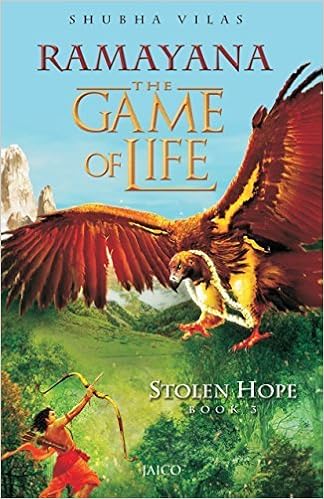
Book Review #81: Stolen Hope: Ramayana Series: Book #3: By Shubha Vilas

Title: The Stolen Hope (Book 3: Ramayana Series)
Author: Shubha Vilas
Publisher: Jaico Publishing
Genre: Mythology
Pages: 300+ (Paper bound)
Source: Review copy by the author


After receiving this book from the author for the review, I’ve thought for a while and purchased the first two books in the series (The Rise of the Sun Prince, and The Shattered Dreams) to get along with the plot and the subplots. Though as an Indian, I’ve known the entire story of the Ramayana and how it had happened by reading numerous books, this book series seems to be very specials regarding its authentic style of narration and the anecdotes, life lessons explained in every page of the book.

The book 1 explains about the birth and growth of the Rama as a toddler to a responsible scion. The book 2 explains the details about the decision of the King Dasharath to coronate Rama as the next king of Ayodhya, and the later events of Kaikeyi asking her two boons from the King Dasharatha resulting in the banishment of Rama to the exile for 14 years and Bharata to be made as a King of the Ayodhya, hence the dreams of the Dasharatha has shattered.

The book 3 begins from the story of the Dandakaranya where Rama, Sita and Lakshmana planned to spend their exile of 14 years. The journey of all three in the forest, their encounters with several rakshasas, and meeting several learned rishis like Agastya, and also the intervention of the Surpanakha and a small fun incident with her that turned out to be a major breakthrough in the story has been captured brilliantly by the author. The killing of Surpanakha’s cousins Khara and Dushana in an epic battle, and a beautiful narration of Rama meeting Shabari has been explained elegantly.

With a brief history of Ravana the story moves on stealthily and Rama is urged to go after the golden deer who is actually Maricha. Then Sita urges Lakshman to go after Rama despite of his unwillingness after hearing her husband's cry.

Ravana comes in form of sinister sage and he praises Ravana and belittle Rama, but Sita praises Rama instead which infuriates Ravana and he takes away Sita. Sita could only inform Jatayu about her abduction. Rama is informed about the abduction by dying Jatayu. Rama meets Shabri who tells them that only Vali can help him find Sita.

There is a short part of story from Lakshman's point of view too.

In-between the relay of the events, the author discusses and analyses certain acts of characters. For instance, at one place, Sita boldly reveals her mind to Rama about choosing the ascetic life instead of his bow and arrow, and immediately the next moment, she could not hold his gaze and begins to stare at her palms. That is, she feels guilty to have counselled Rama. Here the author discusses Sita's act of giving feedback as follows:

Does one have the right authority to give the feedback?
Even if one has the right authority, does one have the right motive to give a feedback?
Even if one has the right authority and motive, is it the right time, place and circumstance to give the feedback?

Although this story is written in parts, it doesn’t feel like it is limited to any particular storyline dividing the epic. The addition of little less important stories all along the way across the entire book has added much value as it would be very useful for the first time readers to obtain sufficient knowledge about the epic. The book is written in a gripping way that it is hard to keep it down, but it seems to be little bit lengthy as we tend to study each and every footnote at the bottom. But to a normal reader the footnotes would provide a Maslin of thoughts which will be forgivable for the length of the reading time.

This book is a must for the readers those who want to know about the Ramayana. Also the author has made this one to be a useful notes by sharing his wisdom and thoughts in every page. Further the summary of the books at the inception of the book makes it clear for the new readers that it’s not a must to read the other two initial books to get a clear view about this particular book.


My Rating:

5/5

Monday, August 3, 2015

Book Review #74: Durgastamana By Ta. Ra. Su

Title: Durgastamana (Durga’s Sunset)
Author: Taluku Ramaswami Subba Rao (Ta. Ra. Su)
Published Year: 1982
Genre: Historical (Non-Fiction)
Publishers: Hamsa Sahitya
Pages: 650+ (Hardbound)

This novel is easily considered as one of the MAGNUM OPUS in the Kannada literature in the field of Historical writings. The author Taluku Ramaswami Subba Rao famously known as Ta. Ra. Su has literally given his life to complete this novel. He started writing this mammoth novel in the beginning of the year in 1981 and completed it in just under 5 months. By end of the year 1981 this novel was completed and by the early 1982, this novel has been released to the public. From that time, till today, this novel has stood against the time and tide and keeps inspiring many young writers who wants to take up the writings of a historical novel.

This novel has been awarded with the Kendra Sahitya Academy (The 2nd highest literary award in India) in the year 1985. Unfortunately, Ta.Ra.Su wasn’t alive to receive this award by himself. His wife accepted this award on behalf of him in the year 1985. The massive research that author has done in creating and writing this novel is evident in every page of the book. Probably, this can be considered as a single reference book to known the life and details of the last ruler of the Chitradurga, the indomitable, the ever loved Madakari Nayaka. 

Reading this novel requires a dedication and patience. It is not at all easy to read a mammoth book of more than 650 pages and grasp every details of it. It is that much detail oriented and it gives us an ample amount of information that need not be verified with any other books.

The novel opens with the death of the King, Kasturi Rangappa Nayaka II, the erstwhile king of the Chitradurga. The wife of Kasturi Rangappa Nayaka II decides to adopt the 12 year old Madakari Nayaka, the son of Bharamanna Nayaka and Ningavva that lived in a village called Janakalludurga (Nearby village of Chitradurga). Soon enough, the young Madakari Nayaka ascension to the throne has been done, and he was soon inducted in to the royal school to learn the art of administration, of war, of ruling, etc… under the able leadership of the Queen mother Obavva Nagathi and the ever loyal minister Kalli Narasappayya. As expected, Madakari Nayaka excels in his studies, his other education specifically designed for to be king. The time has already come to test his knowledge to the use in a small battle against the Rayadurga (Neighbor province of Chitradurga). The young Madakari Nayaka was invincible and soon enough he gains the trust and love of his people by his undiminishing attitude as a ruler. The people of Chitradurga has found their true ruler and extended their support and loyalty towards Madakari Nayaka. During his younger days, Madakari Nayaka has gained the trust of his royal court, his ministers, his family and his citizens and grew up as a much loved King.

The book further explores the details regarding Madakari Nayaka’s learning years and his marriage with Bangaravva, Padmavva and his love interests with the city devadasi girls Kadoori and Nagavva. He remained as a true lover to both of his wives and remained an ever loyal lover to the other two. His family details and discussions were discussed in many chapters and it is connected with the story, which I am omitting in my review.

As the book progresses further, Hyder Ali who was the ruler at the Mysore province and on expedition to expand his kingdom towards north. Initially, he approaches Madakari Nayaka for the much needed help, which was offered by Madakari Nayaka after consulting and taking advices from his minister Kalli Narasappayya. With the extended help from Madakari Nayaka, Hyder Ali was able to win over many Maratha provinces and their friendship grew day by day until an unfortunate event. This Hyder Ali was not a friend and not an enemy to any of his fellow kings, he only wish was to be the undisputed ruler across the India. To make that possible, he was ready to go to any extent. With these crooked thoughts in minds, Hyder Ali places his spies in Chitradurga’s kingdom to collect the information of the war details, like, number of soldiers they had, number of horses they had, number of weapons, bombs, foot soldiers, etc… of Chitradurga’s kingdom. During all these times, his minister Kalli Narasappayya wasn’t aware of these spies, but, not Madakari Nayaka.

Parashurama Nayaka, the younger brother of Madakari Nayaka, who grew up in the school of Minister Kalli Narasappayya, has gained much knowledge in the ministerial proceedings of his Kingdom. Madakari Nayaka appoints his brother to spy on his Minister Kalli Narasappayya to fetch the details regarding the spying from Hyder Ali’s men. To his astonishment, Madakari Nayaka finds out greater details than he was expected, which he questioned his Minister Kalli Narasappayya in the open court, that lead to the resignation of Kalli Narasappayya on the grounds of treason. But, Madakari Nayaka, didn’t take any action on his Minister, rather, Kalli Narasappayya himself resigned from his post and left the city along with his wife to some pilgrimage. 

Days become tough for Madakari Nayaka. After collecting enough information about Hyder Ali, Madakari Nayaka decides to break his friendship with Hyder Ali, which made Hyder Ali furious and decides to go for a war. In these times, Madakari Nayaka writes to Maratha Kings asking their support to fight against the Hyder Ali and his lakhs of man force. But, Maratha’s kings keeps Madakari Nayaka in wait as they were not able to resolve their own internal conflict. The rest of the details are explained brilliantly in the book. 

The final war sequence which covers almost half of the book is what this book is all about. As per this book, the war between Hyder Ali and Madakari Nayaka that went on for almost 8 months to an year is a battle that was never seen before and never after. The intensity of the battle was imagined brilliantly by the author, supported by his strong words and anecdotes. As expected, even in Chitradurga, the Muslim warriors from the Chitradurga’s side will betray Madakari Nayaka at the last stage. They secretly tied up with Hyder Ali and took a vow on Quran to never fight against the infidels. This betrayal cost Madakari Nayaka a great deal. Apart from this, the few leftover Maratha warriors argued about payment issues and never took part in the war whole heartedly. All these events led Madakari Nayaka to face the mighty force of Hyder Ali with his few thousand warriors, with a least hope of saving his kingdom. The results need not be mentioned here, as everyone knows what might have happened. The sun of Chitradurga a.k.a. Durga has set. That is “DURGASTAMANA”. 

Even after these many hundred years. The life story of Madakari Nayaka inspires everyone. His fearless attitude, his untainted charisma, his able administration, is a true testimonial of how great the Chitradurga during his time. A true classic hero of Indian history. Till today, several forts of Madakari Nayaka has been preserved in Chitradurga and made as a tourist place which attracts thousands of tourists every year. A must visit place for everyone. If you have read the book before visiting this place, you might long for those tiny details that you have read in the book. A great compilation by the great author. I recommend this book for everyone. 

My Rating:
5/5

Monday, December 8, 2014

Book Review #48: 1984 (Nineteen-Eighty Four) By George Orwell

“WAR IS PEACE, FREEDOM IS SLAVERY AND IGNORANCE IS STRENGTH”!!

Probably this is one of the most disturbing books that I've ever read in recent times. I had no idea what was happening but I was sure that, I was feeling all those creepiness, all those dreaded ways of torturing people, and most of which, the way an existing government treats its workers for the sole purpose of staying in power.

At the same time, this is one of the classics ever written on socio-political grounds. George Orwell has mastered at the character creation, that it almost felt like the events described in this book might have happened for real. The Dystopia that Orwell had expressed in this novel is quite an amazing thing. Written in 1948, but for the people of 1984 is what makes this book as a unique and class apart.

Winston Smith, the protagonist of our novel, who happened to be an inner party worker. He always hated his government for their way of treating its people. Their totalitarian way of handling things and events resulted in more hatred from among its workers than the normal citizen. Winston was working in Ministry of Truth, a government organization whose purpose is to distort the dates and events and recreate those things as never happened or happened at the behest of the wishes of government. He was often wondering why things are like this and why their government is behaving like this. Their government went a step ahead and created a new kind of dictionary called “NEWSPEAK" that eliminated almost every word that can be used to describe the hatred against their government. This dictionary always uses words such that, there is no way that anyone can write against government, because, those words didn't exist in the NEWSPEAK dictionary.

As the story further progresses, Winston was slogging every day to his work though he hated it. So, he purchased a diary from local market and started to write his hatred against the government in that diary. He had to keep this activity so secret that, his every move, his every step has been watched very closely by his government and Big Brother. Wherever he used to sit, at his home, at office, on the street, there will be special telescreens that will spy on him and often he gets reminders from the same screen whenever they encounter some unusual activities. Not only was him, almost everyone undergoing this surveillance. They are not even allowed to think against their government, otherwise, this will get booked under the act “Thought Crime”. There are few cases like people were booked under “Thought Crimes” and there are “Thought Police” everywhere in the city to keep an eye on these people.

During these events, he meets a female co-worker Julia from his office that expresses her interest towards Winston. Initially he was skeptical that, she might be an inside informant who is spying on him. Later, he comes to know that, even she hated the government. So he accepts her proposal. They usually go to the woods to spend some romantic time together, since, couples who are going together and are not married is a crime according to the government. So, Winston rents an apartment in the 2nd floor of an antique artefacts seller.

One fine day Winston meets O'Brien, a colleague of him that pretends to hate their government and Big Brother. He befriends him and reveals all his details and his love affair with Julia. Initially, O'Brien acts as if he is the member of secret group and hands over a book of secret group to Winston to study. He collects all the information from Winston and pretends that they can work together and bring down this government. Winston believes in all these things and along with Julia will head back to their apartment and begins to study that book. This is the longest section from the novel where Winston reads and understands everything about their government and the secret group. In all these events, both Winston and Julia were certain of one thing, they believed that they will get caught sooner or later by their government or people from Big Brother and will be executed. During this phase, their apartment door will be kicked open and both of them will be arrested. The owner of the apartment Mr. Charrington, who pretended to be a normal person, is actually one of the “Thought Police”.

So, both Winston and Julia will be arrested and will be put in separate prisons. This section of the novel is the disturbing section. Winston will be tortured like anything and made to accept to all the crimes that he has committed or not. The twist in the novel appears now, O’Brien, who happened to be a member of the secret group is actually a spy working from outside the party and working for Big Brother. He confronts Winston and reveals his true face and explains Winston about all his spying activities. He tortures Winston in all possible ways and forces him to confess everything. O’Brien transfer Winston to Cell 101, a dreaded torture room specifically designed to torture people in the cruelest way and will be made to confess almost anything that they wanted, even though they never committed in the first place. According to O’Brien, Winston and Julia have committed Adultery, they committed thought crime, they are traitors, they worked against the government, etc… But, all O’Brien wanted from Winston was to forget Julia. He tortures Winston and brainwashes him in such a way that, Winston almost nods for everything and even he accepts 2+2=5!!

Finally, O’Brien was able to brainwash Winston successfully. His final resort of torturing Winston by allowing the rats to eat Winston’s face in a closed box proved to be successful. Winston who often gets dreams of eaten by rats was actually coming true. He decides to confess to his final crime and says to O’Brien that he can torture Julia instead of him. This is the final answer that O’Brien was expecting from Winston. Finally, Winston will be released and was allowed to live like normal Proles. Winston encounters Julia in later days after his release, but, he will realize that, he don’t have any feelings left for Julia.

Overall Winston’s journey is completely filled with torture. He realizes that, one alone cannot do anything against the government. The realization from “I hate Big Brother” to “I Love Big Brother” is a complete brainwashed phenomenon.


I recommend this book to be read by everyone. This book is truly a masterpiece and covers the post war details of the country Oceania in greater details. Though it’s a fiction, but, nobody will come to a conclusion that this novel is purely fictional tale oriented!! The 3 sentences from the novel will be reverberated in your head even after finished reading it. “WAR IS PEACE, FREEDOM IS SLAVERY AND IGNORANCE IS STRENGTH”!!

My Rating:
5/5

Buy 1984 from FLIPKART.COM:
LINK