Showing posts with label Kannada Book. Show all posts

Tuesday, June 9, 2015

Book Review #68: Karma By Karanam Pavan Prasad

Title: Karma
Author: Karanam Pavan Prasad
Publishers: Conclave Media
Genre: General Fiction
Pages: 164 (Paperbound)
Source: Personal Copy


A first time debutant novelist, who took greater risk to write a novel on a subject like Death, Hindu Funeral Rituals and practices, etc… This novel is a blend of age old rituals, beliefs and traditions versus the modern cosmopolitan, scientific, questioning generation. This novel deals with a very taboo subject such as Hindu funeral practices, which is also called as KARMA, hence the title of the novel Karma. The book poses some serious questions, at the same time, gives its readers a sense of newly crafted novel. Not that, this kind of novel has ever come before, in fact, it has come at various stages and in various forms. But, the mixture of modern aspects like smartphones, IT, KFC, drinks, parties juxtaposed with that of traditions, practices, beliefs and other things is a new way.

The protagonist of this novel Surendra was responsible to carry out the last rites rituals of his father that just demised. Being working in a city as an upscale Engineer and married to an ultramodern woman Neha, he didn't seem to get adjusted to all those rituals, practices and traditions. He just toys around like a puppet listening to the head priest and following his younger brother in those rituals. During these proceedings, Surendra refuses to gets his head shaved, whereas, his brother Narahari agrees to it. (This is one of the rituals, where, the sons of the deceased person should get their head shaved in order to carry out this ritual, it’s called VAPANA). Day to day proceedings was making our protagonist lose his cool and made him act like a weirdo. He was always suspicion about his wife. He often gets these thoughts that; his wife is cheating on him with another man. This is strongly believed by him due to the past actions of his wife on numerous occasions before marriage. His wife had many partners just like him. However, his manly thoughts were not convinced to agree on such things.

The regular circumstances of those rituals have made him to come to terms with the traditions and he actually starts believing in everything. He often reaches out to head priest to understand the basics of the rituals which he finds occasionally funny. Sometimes, he indulges in serious conversations with the head priest and was asking any ritual practices so that he could father a child and so on. This kind of dilemma and regular taunts from his wife for being too orthodox has made our protagonist weak day by day. He gets mocked by his wife for conducting those ‘pointless’ rituals which was seriously offending Surendra. He also concludes that, he didn’t get a proper wife or he didn't become a good husband. This made him to get back to his last love interest ‘Vaani’ who was his Aunt’s daughter. Even here he faces serious disappointments.

As the book progresses further, we will realize many facets of these funeral rites, and this must be the take away from the book. The detailed explanation and beliefs behind each practice and tradition has explained pretty neat. There is an absolute twist at the end of the novel, which I am not including in my review. I ask people to read and savor the story.

All said and done, the novel has some weak points. Few of the characters were given little space. The entire novel could’ve been extended to about 30 pages. The background story of important characters was missing or was kept low. The Sanskrit verses and their meaning throughout the novel is a good attempt at explaining few traditional aspects.

Overall, a great attempt by the author and a fantastic rendition. He has a long way to go and this is just the beginning. I hope to see more of such amazing work by this author. Though, this book can be easily considered as a contemporary novel. It doesn't exactly belong to any specific genre. A must read novel. I recommend it for everyone.


My Rating:
5/5

Thursday, June 12, 2014

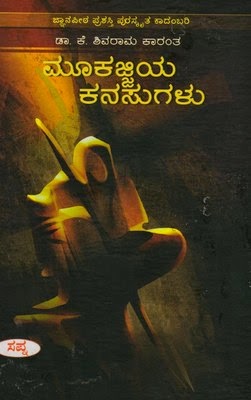
Book Review #16: Mookajjiya Kanasugalu By Dr. K. Shivaram Karanth

Every Indian who grew up watching some of the notable authors getting conferred with Jnanpith_Award sometime or the other. Usually, this award will be given to the authors for their notable literary works. The regular held notion of any of the Indian readers that, to win a prestigious award like Jnanpith, the author has to write a voluminous book that lasts hundreds and hundreds of pages. Well, I can't completely agree or disagree with that. The reason being, the book which I am reviewing in this post.

Dr. K. Shivaram Karanth, Kannada's renowned author was awarded with the Jnanpith for this book Mookajjiya_Kanasugalu in the year 1977. This book is just about 270+ pages, but, the quality of the writing and the plot of the novel is epic. Novel is very profound and thought provoking which actually makes the reader to question themselves about various basic questions of everyday life, like God, Culture, Belief, Sacred texts, Bhagawad Geeta, Death, Rebirth, Evolution etc, etc..

The title of the novel can be translated to english as "Grand Nanny's Dreams". The heroine of the novel is an 80 year old grandma named Mookambike who is the grandmother of Subraaya, the 2nd protagonist of the novel. Story which is set in a village called Mudur which is near to Shimoga district of Karnataka.

This book narrates the interaction of the grandma Mookajji and her grandson Subraaya about various subjects and situations. Subraaya poses various questions to his grandmother and through her response author tries to convey his ideas about the various topics in an easy and understandable way. Author's thought about the various subjects like God, Culture and other aspects is very elegant.

The journey takes the reader like a smooth wave of wind in every page and makes the reader to longe for more questions that Subraaya must ask his grandma. Readers will be so engrossed and wish even they must have such a grandma after all.!!. Though there are multiple characters in the book, the book mainly focuses on Subraaya and his questions for his grandmother and of course her answers. Subraaya is an educated man, but decides to stay in the village by looking after his land and farms. But his college degree in history makes him to learn more about history and he always believed that, his village Mudur has a long lasting history of more than 1000 years. He often tries to go into forests and caves around his village and collect some of the old artifacts and show it to his grandmother to know the details of those items. He always beleived that, his grandmother had special magical powers that, with just a touch of things, she can able to recall most of the history behind those artifacts. This special quality of Mookajji what attracted Subraaya, that made him to pose hundreds of questions everyday. At the same time, Mookajji is happy to answer all of his question in her own way which is the lucid part of the novel.

The best takeaway from the book is when Subraaya poses questions on God's existence and the answers given by granny Mookajji in her own way makes the reader to chuckle. Mookajji had her own belief and stories about Idol worship, Tantric experts, Jainism and Buddhism. According to the book, Mookajji was able to visualise many of the things as if it is happening in front of her eyes. These events made Subraaya to ask many questions and he enjoyed the various stories told by his granny.

Overall, going by the content and quality of the book and the simple way it was presented, I recommend every reader who is really eager to read yester year's kannada books, must read this awesome book. It has lots of comic incidents and more than that, it has food for thought for the readers. I will assure you that, the time you spent on reading this book will not go wasted. It increases your perception and gives you a new ray of light for looking the things that you have seen all these years, in a different way. The Jnanpith award for this book is greatly justified. Author had shown us the way, in which, even the most complex thoughts and ideas can be presented in a simple, understandable way.

My Rating: 5/5

Wednesday, June 11, 2014

Book Review #15: Chomana Dudi By Dr. K. Shivaram Karanth

There are few books which completely takes the readers into a trance and leaves them for several days. "Chomana Dudi (Choma's Drum)" is one of such books. With full of emotions and tragic sequences in the entire novel leaves the reader spellbound. This is one of the short stories written by Kannada's ace novelist, Jnanapith award winner Dr. K. Shivaram Karanth in 1933. This book entirely focuses on the untouchability practices that was rampant in India during that time. The main protagonist of the novel "Choma" is an untouchable or what we popularly call as "Dalit". 

This short book has been made into movie in the year 1975 under the same title directed by B.V. Karanth. This movie has won the Swarna Kamala award from president of India.

The practice of untouchability is not new to India, it is much worse than racism. Author has elegantly captured all these practices and given the shape of a journey of a man called "Choma" and his beloved "Dudi" or "Drum".

Choma is an untouchable bonded labour in a village. He and his entire family was working for a landlord in a village, as he was not allowed to own a land and till on his own. Due to the tag of a backward class, Choma was not allowed to till any land, which he has desired the most. Though he had acquired a pair of bullocks from a nearby forest, he wish of owning and tilling a land remained a dream after all. This has frustrated him for life long and to forget his sorrows and show his anger on the society he gets drunk every night and starts playing his Dudi or Drum.

Without much success with any of his landlord, Choma was contacted by some Christian missionaries who intimidated him to get converted to christianity by offering him a piece of land to till. Though choma was interested at the beginning, later he rejected that offer and felt proud of his faith and religion.

Choma has 4 sons and a daughter, 2 of his elder sons Guru and Chaniya who were working in a coffee estate far away to pay off the debt. Chaniya dies of Cholera and Guru converted to christianity and marries a christian girl and never visited his father ever again. Here, choma's daughter Belli, goes to the same coffee estate to pay off his debt, who falls prey for Manvela, the writer of coffee estate's owner. She was abused constantly and even the estate owner had raped her often and one day sends her off from the coffee estate saying the debt was cleared.

In Choma's village one bad day, his 2 younger sons were playing near the river and accidently one of his son slips into the river. Since, they were untouchables none of the other villagers couldn't come forward to help him to save his son. All these events had eventually made Choma to lose his senses. He lost his sense and was always staying at house without going to labour work and often playing his Dudi (Drum) in a deafening noise to forget his tragic fate. When he thought everything was over, he and his daughter Belli decides to join Guru, and accept christianity.

Choma decides to go and meet his son Guru, he leaves his village. When he was half-way, he changes his mind and decides whatever happens to him, he is not going to change his faith and religion. By deciding this, he heads back to his house, but, he saw an unexpected scene at his house. His daughter Belli was seen in a compromising position with Manvela, who was that writer of that coffee estate. Full of anger, Choma beats his daughter and throws her out of the house and he chases off his bullocks into the forest and comes home, locks himself inside the house and starts playing his Dudi or Drum non-stop till he breathes his last breath. This marks the end of the book.

Choma's dream of becoming a farmer and tilling his own land remained a dream after all. Throughout all his tragic fate of incidents, only his Dudi or Drum remained as a loyal friend to him. Just because he was an untouchable, his entire village was against him and never allowed him to till his own land.

A must read book, it just opens you to an entire new world. Also, it teaches a great lesson to learn humanity first rather than clinging to one's own religion. The oppression Choma faced in this novel is beyond imagination. I have left with only one question, when this upper-caste, lower-caste altogether the caste system will be thrown out of this world ?

My Rating: 5/5

Monday, June 2, 2014

Book Review #13 - Sartha By Dr. S.L. Bhyrappa

There are few books that can easily translocate you into an alternate universe. Sartha penned by Dr. S.L. Bhyrappa is one such book. From among his many gem of novels, Sartha surely finds place in top 5 without a doubt. This is one of the profound works of Dr. SLB sir under historical fiction category.

Sartha first published in 1998 in Kannada have seen numerous reprints in the following years. Later, this book got translated into all the major languages of India including Sanskrit. The beauty of this book lies in its usage of the various sanskrit verses which is tactically adopted to the novel. This book translated to English under the title "Sartha - The Caravan".

Sartha which literally means trading caravan of ancient India. This book is a physical as well as a metaphysical journey that takes the protagonist of the novel; a vedic scholar Nagabhattta.

The entire story takes place somewhere around the 8th century CE. This era mainly depicts the historical, political, economic and religious conditions of India. This is also the period where Buddhism was at its peak in India, followed by other monotheistic religions.

The protagonist Nagabhatta is a well educated vedic scholar trained in famous Mimamsa under an ace guru Mandana Mishra. Nagabhatta lived in a kingdom called Taravati. King Amaruka was ruling this Taravati state. This place is a fictitious place created by the author somewhere between the Northern and Southern India. Amaruka is also happened to be a good friend of our novel's protagonist Nagabhatta.

The plot opens when King Amaruka, who insists Nagabhatta on a voyage to understand the various trade secrets of other countries and kingdoms. Nagabhatta, leaving his wife and his mother begins his epic journey along the trade routes of ancient India. Having disguised himself as a student of religious studies, he joins a Sartha group and travels along with them. He informs the Sartha headman that, he is heading to Kashi to study the advanced vedic subjects. But in reality, his intentions was to know the trade secrets and thereby helping his friend and king Amaruka.

It so happened one day during their journey that, the Sartha group leaves Nagabhatta in a town and informs him that they are heading to a different direction. The headman of the Sartha group takes Nagabhatta to a nearby Buddhist temple and arranges a stay for him by talking to a Bhikku. Here, Nagabhatta explore various intricacies of Buddhism and other stories of it. This will gradually makes Nagabhatta to foreget his mission of finding the trade secrets.

This event marks an impact on Nagabhatta's ideas about all religions. Thus, his tryst with various religious subjects, practices, cultures, and philosophies beings. This also led Nagabhatta to realize himself more deep and deeper.

Without going much deep into the novel. I will only highlight the important events of the novel, thereby maintaining the surprising stories of the novel in between. In the course of his stay at Buddhist temple and wandering the places around he encounters Buddhist Bhikku's, Yogi's, Left hand tantric experts (popularly known as Vamachara). He also meets Adi Shankaracharya, and Kumarila Bhatta. Having an emptiness throughout his life and in order to find a purpose for his life, Nagabhatta tries his hands in all of these practices. He starts to learn Yoga, at one point in the novel he becomes an Aghori by joining some Naga Sadhus. He also tries to revive his vedic studies and finally he visit the first university of the world Nalanda.

The vivid description of the Nalanda University is an awesome attempt by the author. He describes the length and breadth of this ancient university. He also emphasizes on various subjects that might have been taught at this university and the number of students that might have studied at one point of time, etc...

As the book progresses further, Nagabhatta loses his interests in finding out the trade secrets. He just wanders many cities, forests and countries. Finally, he settles down in a town where he joins a troupe that enacts the episodes from the chronicles of life of Sri Kirshna and Sri Rama. Here, he befriends Chandrika a fellow artist in the troupe and the female protagonist of the book. She was a lead female character in the troupe. She was a good singer and known to practice yoga as well. Nagabhatta took interest in her and soon their love story takes another track in the novel.

As the novel progresses towards the end, various circumstances leds Nagabhatta to witness an epic debate between his guru Mandana Mishra and Adi Shankaracharya. This debate was presided by Ubhaya Bharati, the wife of Madana Mishra. This debate was mainly based on the vedic related topics. Outlines of this debate, which leads to the defeat of Mandana Mishra at the hands of very young Adi Shankaracharya. This loss made Mandana Mishra to become a disciple of Adi Shankaracharya.

The interesting section arrives when Ubhaya Bharati, wife of Mandana Mishra, tries to save her husband from becoming a follower of Adi Shankaracharya by leaving everything. She poses various questions to Adi Shankaracharya, which leads Adi Shankaracharya to find out the details about Parakaya-Pravesha.

At the very end of this novel, Nagabhatta's troupe was performing in Mulasthana which is present Multan.
This was controlled by Arabs at that time. Arabs have disrupted the fair practice of Sartha. There is an interesting tale of Arabs trying to destroy the Mulasthana temple and Nagabhatta's troupe is trying to garner enough support from the local populace for a coup. But, these plans were failed miserably, which was severely dealt by Arabs. Arabs have detained Nagabhatta and Chandrika. Nagabhatta was severely tortured whereas, Chandrika was brutally raped. Getting released from the clutches of Arabs, Nagabhatta and Chandrika decides to runaway to a far place and finally decides to get married. This marks the end of the book.

The canvas which the author sets for his novel is very panoramic. A transition period in India where there was a lot of turmoil. There were lot of cultural clashes, Buddhists, Purva-Mimamsa, Tantric and Uttara-Mimamsa, etc... And, our protagonist's roller-coaster ride; Advent of monotheistic religions to India. The author presents before us a work of historical fiction where little damages has been done to the historical accuracy yet leaving enough room for him to build his plot very creatively.

Finally, the language used is very simple but so powerful. With many sanskrit verses used in between the story is very apt and justifiable. I find this in all works of Dr. SLB. It is certainly a treat to read him. Only his readers can experience the joy in his works and one is hard-pressed for words to describe the whole reading experience.

My Rating: 5/5

Wednesday, May 14, 2014

Book Review #11 - Matadana (Casting Vote) By Dr. S.L. Bhyrappa

Matadana (Pic Source: Internet)
This is a simple but elegant novel penned by Dr. S. L. Bhyrappa. Unlike his other novels, this novel is not interwined with so many characters. Rather, it is quite straight forward. The main theme of this novel is about the elections, politics of a small village. Interlaced with engaging characters and adding a portion of Tragedy and family problems makes this novel as one of the best fiction novels of Kannada literature.

With a strong plot this book makes it an easy adoption for movie. Without surprise, this novel has been adopted to movie that goes with the same name as "MATADANA" directed by one of the renowned directors of Kannada movie industry T.N. Seetharam in the late 1970's. This movie has won the best regional movie golden award from the President of India at that time.

The main protagonist of this novel is a well educated, MBBS grad, simple man Dr. Shivappa, who was practicing in his village by serving poor people. Shivappa's family consists of his mother Kallamma and an elder sister. His father was already dead even before the novel starts.

The other main characters of this novel is, Ramalingappa Gowda the popular contractor of neighbour village. His 2 daughters Kempalakshmi (elder) and Rangalakshmi (younger). His son-in-law Putta Tammayya who married Kempalakshmi. Mr. Appaji, the local elected MLA, now a minister. Mr. Sadaravalli and his son Mr. Prakash Sadaravalli, who was the political rivals of Mr. Appaji and Ramalingappa Gowda. Mr. Appaji and Ramalingappa Gowda were close acquaintances. Through Mr. Appaji, Ramalingappa Gowda has acquired many contract works in his village. And lastly, Cheluvashetty, a close friend and adviser for Dr. Shivappa.

The plot opens when Dr. Shivappa goes to see Rangalakshmi for a marriage proposal. This meeting was setup by Shivappa's mother Kallamma. Reluctantly, Shivappa agrees to see this girl, but never accepts for a marriage. Shivappa had a thought in his mind that, once he marries, he has to increase his earning, which makes him to leave the village and start his practice in some city, which is totally against his principles. Shivappa had always thought to server poor people and hence he has declined serveral high paying jobs from various hospitals from city and decides to practice in his own village.

Though Shivappa liked Rangalakshmi and it was reciprocated from Rangalakshmi as well. Shivappa declines that marriage proposal once and for all. He continues his practice without giving a much importance to his marriage.

As the story further reveals, Kempalakshmi would die of pnuemonia and hence Putta Tammayya along with his kid Manjayya comes to Ramalingappa's house to ask him to get married him to Rangalakshmi again. Here author tries to tell us that, through Mr. Appaji's influence, Ramalingappa had succeeded in getting a good government job for Putta Tammayya, which was supposed to go to Prakash Sadaravalli. Ramalingappa agrees to this marriage proposal reluctantly, and hence Rangalakshmi was married off to Putta Tammayya for the 2nd marriage.

Now the actual plot opens up, when the general elections was declared in the country. And, all political parties were in a frenzy in selecting their candidates and canvassing for them, etc... Even few lawyers and other influential people from city comes to Shivappa's house one day and asked him to contest for elections, because Shivappa as a doctor has garned much respect and popularity in the neighbour village. Finally Shivappa agreed to contest in elections. Even Mr. Sadaravalli's son Prakash Sadaravalli is also contesting in the same constituency along with Mr. Appaji, thereby making it as a triangular fight between himself, Shivappa and Appaji.

Now, the twist in the novel appears, though Shivappa agreed to contest in elections. This was a sheer game plan of Mr. Sadaravalli to finish the political carrier of Mr. Appaji by appoiting an honest man like Shivappa to contest in elections, mainly for the reason of polarizing the votes that used to go to Appaji, now will go to Shivappa and his son Prakash. Without understanding these things, Shivappa with full enthusiasm particiaptes in campaignings, meetings, gave speeches. One day, his close aides reveals him that, the opposition parties are distributing money and they must also do the same with villagers. Speeches alone cannot help to win elections in village and they demand money as well. This was again a plan of Sadaravalli to distribute money to villagers in the name of Shivappa. Villagers till now beleived Shivappa as an honest man, now in a doubt once Shivappa started distributing money.

Off late, Shivappa understood that he was made as a scape-goat in the elections. Without a surprise, Shivappa lost the elections and Prakash Sadaravalli have won with a huge margin winning against Mr. Appaji.

Soon the new government was formed, making Appaji powerless. The new government in which Prakash Sadaravalli was also a part of, ordered a probe against Ramalingappa's contract work. They set up a committeee to investigate all the contractual works of Ramalingappa. Ramalingappa has minted lot of contractual money when he was getting the support from Appaji. Now, he became helpless, he decides to seek support from Appaji. He was disappointed that Appaji couldn't able to help him in any way. Here the new committee has ordered Ramalingappa to pay all the money that he has minted in contracts. Ramalingappa tries to seek his son-in-law's support, disappointed there also, he sells his land in the village for a nominal price and tries to settle some of the dues. Having learnt that, the new committee is all set to put Ramalingappa in jail. Frightened for his reputation in the village, Ramalingappa commits suicide by jumping into a nearby dam in the village.

Here, Rangalakshmi decides to leave her husband Putta Tammayya comes back to her village and decides to take up the nursing course and was wishing to work with Dr. Shivappa.

Having lost his mother and damaging his reputation as an honest man by contesting in elections, Shivappa had no interest in practicing in his village. He seeks his friend Cheluvashetty's advise on this. One day when Shivappa was treating Cheluvashetty's wife in a hospital. He saw Rangalakshmi working as a nurse in the same hospital. Without a second thought, he goes and proposes to Rangalakshmi. Wishing for the same, Rangalakshmi had also agreed for this proposal. And they lived happily ever after.

My Rating: 4/5

Monday, March 17, 2014

Book Review #1 - Aavarana by Dr. S.L.Byrappa

As I start to write my first ever review of many books that I read in past years. For sure, this books tops my list. It's sheer magnitude of information will make anyone drool for more. It is thought provoking, as well as bit controversial.

As many Indians in India, who put a "Secular" tag on their foreheads, will hate this book to the core. But they cannot ignore the facts, that has been put up in this book. With most number of reprints to its accolade, this book for sure, will make anyone to think about the distorted facts of our country India. And for those "Seculars" who hate to discuss the facts that India have been through over many centuries, the attrocities faced by Indians from the Moghul Invaders and their barbaric events that had a serious impact on our cultural, religious and sentimental beleifs.

Let's dwell straight into the review.


At the beginning of the book, the author Dr. S.L.Bhyrappa expresses the meaning of Aavarana. By giving profound examples from Advaitha, Vedantha. He tries to portray Aavarana as the maya or the illusions, or the cover. And, he tries to uncover this Veil through this book.

It is not a simple task to take up this kind of writing. It requires great courage and conviction to come up with such a factful book, unleashed in a fictional story. In just about 300 odd pages, Aavarna uncovers the most hidden historical attacks on Hindusim by Islam's encounter in India.

The book opens with RAZIYA, a middle aged documentary film-maker, a feminist by heart and soul, who has been married to AMIR. The plot opens when RAZIYA was assigned to do a documentary movie on the ruins of HAMPI, the cultural captial of Karnataka. Her Husband AMIR who is the director incharge of the doucmentary movie that they are going to shoot at Hampi.  The main motive of the documentary movie, which was funded by a 'Secular' government that, to portray HAMPI as a resemblence to a Hindu-Muslim brotherhood. When RAZIYA learns to understand the actual cause of the wreckage in HAMPI, she began to go through her own life memories which led to her today's life.

Now, the author brings up the younger days stories of RAZIYA.

When RAZIYA heard about her father's death, she decides to go back to her village to see her house in HASSAN district. The village which she left about 28 years ago, protesting her family to marry AMIR. As she came inside her father's house. She examined a small library that her father built up for himself to study about the history. She was asotnished to find several volumes of literature books, about Islam's encounter with Hindus. Her father also left with a note of summary on each book that he has completely read and understood. As she starts reading those books, she gets reminded herself about what her father had warned her, when she decides to marry a muslim boy AMIR. "Lakshmi, one day, you will realise in future, that, your own descendants will destroy our temples".

This is a twist in the plot that, RAZIYA was a Hindu before marrying AMIR. Her real name was LAKSHMI.

Lakshmi's past begins to play in her mind in her father's room. How she was a successful bright student in her college days, How feminist activist she was in her college. How she used to give so many debates about equality that is required for females in the country, etc.., By having this modern mindset, she decides to marry her classmate AMIR that she was in love with. Despite getting married to AMIR, Lakshmi never understood, why she has to change her religion and practice Islam. In reality, AMIR was not as broad minded as LAKSHMI thought he was. He insisted her to change her religion, otherwise, their marriage will not be accepted by his parents. Her first rift with AMIR comes up when he forces Lakshmi(Now Raziya) to eat Beef. Similar to this, there were numerous tryst that she faces during her married life with Amir over these 28 years. They had a son, who is a Graduate from a USA university but found a job in Saudi-Arabia. Living in Saudi-Arabia and having spent most of his childhood with Amir's parents, he has turned out to be a hardcode Islam by heart.

Present..

Now Lakshmi decides to stay back in her village and decides to read the entire literary collection that her father has collected over many years. From now onwards, author Dr. SL.Bhyrappa gives another story inside the story which unveils the actual Islam encounters with Hindus, through Raziya reading her father's books.

She reads everything starting with Tippu Sultan and the numerous robberies that he has conducted over many years in Kerala and Karnataka. And, numerous forceful conversion of "Infidels" to Islam either by submission or by force. And, how Tippu Sultan tries to bring in PERSIAN as a primary language and business administration language in Mysore Province. (In Tippu's era, the whole Karnataka was being called as Mysore province).

As she skims through books after books, she encounters a tale of a small Hindu kingdom which had serious conquest with Moghuls. Everybody had died in that conquest, except the Younger Prince, who had been married recently to a younger girl. Author, SL Bhyrappa also describes the practice "Jouhar" during those time, which is every female persons in the family will commit mass suicide, than getting raped by the rutheless Moghul invaders. And, every male person will fight the battle till his last breath. During this conquest, the younger prince is captured, and a very famous temple has been smashed to ashes, and the main diety idol has been vandalised. The captured younger prince has been tortured, abused him for Homosexual desires of Moghul invaders, and he was forcefully sex changed to be a Hijda. And later he was sold as a slave to a Mullah and he was renamed as Khwaja Jahan. One will feel really bad to know the process of Castrating people in the Moghul days. Author has explained it in details which can be read in the book.

The books depicts the slavery system that Moghuls used to carry out on Hindus in India. The book also describes, how the centuries old civilization, religious beleifs, practices, harmony among many people has been destroyed by Islamic invaders. It also shows about some people who tries to oppose them and tries to preserve our culture.

SL Bhyarppa also tries to describe our Seculars, Modern thinking professors, Progressive writers in India who thinks that history being distorted and all the facts about Islamic barbarism in India is all lie and they went a step ahead and portrays Islamic rule as the progressive, peaceful era of our country. To give details about these persons, SL Bhyrappa created a character called as "Prof. Shastri", who is a lecutrer of LAKSHMI in her college days, and who is married to a christian when he went for higher stuides in England.

Overall, the book raises an important question of Hindusim on a comparison with Christianity and Islam. The western countries have already rejected the notion of keeping religion as a base to rule the country and brought in the democracy. So does India, being a world's biggest democratic nation, Indians especially Hindus have faced a lot of opressions from Islam invaders through many centuries.

The critics always tries to demote Aavarana by giving lectures about how fundamental thinking this writer has. This is hard Hindu fundamentalist thinking, etc..etc.. the blabbering goes on every day since Aavarana has been released to the stores. They even managed to stage protests against SL Bhyrappa and demanded government to ban this book altogether in India.

To everyone's surprise, this book has been recorded with highest number of reprints, and got translated to more than 10 Indian languages. Recently it got translated to english as well. The english titled book of Aavarana is "Aavarana - The Veil". You can purchase the book here Aavarana - The Veil

Conclusion:
How long do we have to ignore the threats of these radical thinking Fundamentalists ?, There is no progressive change from Babur, Akbar, Aurangazeb time to Osama Bin Laden these days. What motivated those people in those days, Bin Laden has the same motives when he attacked twin towers. Besides, what passes as medival history is a mere interpretation. That's Aavarana.

My Rating: 5/5