Showing posts with label Practice. Show all posts

Tuesday, September 15, 2015

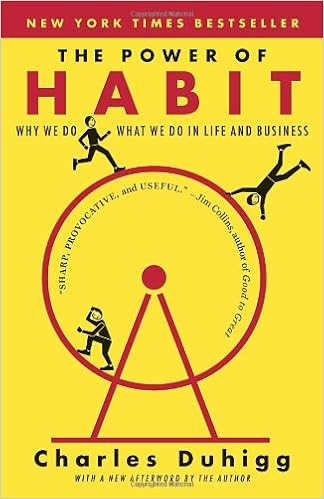
Book Review #77: The Power of Habit: Why we do, What we do in Life and Business By Charles Duhigg

Title: The Power of Habit – Why we do, what we do in Life and Business
Author: Charles Duhigg
Publishers: Random House
Year: 2012
Genre: Non-Fiction/Human Psychology
Source: Personal Copy

The book which explores the human habits and why it is called a habit after all. The author Charles Duhigg explains with various anecdotes from the scientific background, behavioral aspects and psychological aspects. The human habit is not something which will occur accidently, rather, it is a practiced phenomenon. This book explores this very idea of how the humans forms their habits, and the reason behind it and the inference of those habits.

This is an exceptionally written and researched book. It breaks those age old practices or the beliefs of "You can’t teach an old dog, new tricks”. Habits can be formed at any age and in any time, given, there is an enough room for acquiring the taste for it. This is really an important book and it can be used as a curriculum if you ask me. It has various examples from various cases studied for many years.

This book is mainly organized in to three different sections of habits. The habits of an individual person, the habits of an organization or a company and finally, the habits that propagates in a society that impacts the people on a larger scale. The case studies explained in every case is a testimonial of how the habits can truly become a game changer if we observe it closely. Thanks to the author. He has cleverly observed and recorded some events and cases where people can view a different angle of what the habits, why the habits and how the habits will occur and how to really change it!!

In the individual habits section, author had written an example of a person that was suffering from acute memory loss. This person went on to become famous as per those medical institutes that studied him over many years. This man was subjected to various experiments, practices and tests and recorded the results. A memory loss patient who cannot remember anything more than a minute or so, can truly practice some things repeatedly so that it can become his habits. A more of his case can be studied in the book.

In the organization example, Author had explained the cases of the famous toothpaste company Pepsodent and how this company went on to create a huge market for itself across the world, just by observing some habitual practices of people and changing the way it was marketed. People, who were not so confident about this product, has changed their minds and created a habit of brushing their teeth with Pepsodent. A more about this can be read in the book.

Finally, habits that changes the society. Author had used some of the famous examples from the American history to describe this section of the habits. The case of Montgomery bus boycott event has created a mass appeal among the people and it went on to create an important event in the history of America, drawing political personalities and other popular figures like Martin Luther King Jr. into the scenario. This case was explained brilliantly in the book and makes people to think about the habitual practice a society endorses. More about this can be read in the book.

All three section of habits draws a simple conclusion. The habits are formed in just a three step procedure. The “Cue”, the “Routine” and the “Reward”. Be it any habits like Smoking, Alcohol, Gambling, Marketing, Health care, etc... Etc… is formed in this three cycle of cue, routine and reward. For you to change any habits of yours and finding it difficult to break that cycle, Author had simply put in this amazing three sections to observe and change accordingly. Author has asked people or organization to not to change the Cue or the Reward. But, just change your Routines to achieve the same Reward. This is explained brilliantly in the following diagram.


A must read book for all those science enthusiasts. In fact, this book can be read by anyone who are in a dire need of changing their habits. It actually helps them to look deeply into their habitual routine and offers them to change a bit or two, so that, they can overcome those usual routines and achieve the same reward.

Few quotes from the book which I really liked:

“It is facile to imply that smoking, alcoholism, overeating, or other ingrained patters can be upended without real effort. Genuine change requires work and self-understanding of the cravings driving behaviors.”

“The Golden Rule of Habit Change: You can’t extinguish a bad habit, you can only change it.”

“…hiding what you know is sometimes as important as knowing it…”

“Rather, to change a habit, you must keep the old cue, and deliver the old reward, but insert a new routine.”

“This is the real power of habit: the insight that your habits are what you choose them to be.”


My Rating:
5/5

Monday, October 6, 2014

Book Review #39: Tabbaliyu Neenade Magane By Dr. S.L. Bhyrappa

This book talks about the conflict between people who are traditionally grown up, holding up the age old rituals and cultural practices and with the people who are educated with the modern viewpoint of the world. So the story captures this essence of what is morally right and what is scientifically right.

 Author SL Bhyrappa is a true gift to the Kannada literary world. His tales varies from social issues till modern space science. He is the only author that doesn't conform to a specific genre. He writes on many themes and many beliefs. That’s what I liked about SL Bhyrappa Sir. He has surpassed his limits in this particular book ‘Tabbaliyu Neenade Magane’ which can be translated to English as ‘Son, You've become an orphan’.

 The story is very sensitive and controversial. It captures the theme of cow slaughtering versus cow protectors in a small fictitious village. An aged person Kalinge Gowda, who believes that cows are the representation of Gods that descended upon earth. Kalinge Gowda belongs to such a revered family, where a cow has offered herself to a hungry tiger willingly ages back. This cow is popularly called as ‘Punya Koti’. A breed which is believed to be sacred than all other cows. Kalinge Gowda has a grandson Kalinga, who was graduated in Agriculture from the University of USA. Kalinga has married to Hilda, a US citizen. Kalinga has a friend in his village, Venkatramana, a vedic scholar and a middle school teacher who believes in every traditional practices and rituals.

The entire villagers were against the slaughtering of the cows, whether it is aged old or a young one.  Hilda the wife of Kalinga was distracted initially to get adjusted to the villagers. She seems to have lost all her independent life of US after coming to this little village. She has to sacrifice her beef consumption. Married to an Indian man, she found it very hard to get adjusted. Kalinga who was very careful initially tries to win the heart of villagers and his friend Venkataramana. But to his dismay, in whichever way he tries to reconcile with the villagers, it was backfiring. One incident where Hilda killed a cow in her farm and ordered her cook to prepare beef, resulted in the severe repercussions from the villagers, which made Kaling to apologize in front of entire villagers.

The book has this kind of conflicting stories throughout. When Hilda questioned Venkataramana about the animal sacrifices juxtaposing it with the cow slaughtering, she won’t receive a convincing answer. All in all, Kalinga and Hilda felt that they were out casted from the village and felt lonely and rejected. All this made Kaling and Hilda to leave their village once and for all and go back to USA.

The climax part of the novel takes an unexpected turn and leaves it readers with surprise. I feel that’s the best part of the book. I will not reveal that in my review. It has to be read from the book itself. After reading the book, every reader will face with few questions that they couldn’t find answers. What is more important in a society? Upholding the age old practices and thereby respecting our culture and customs or compare every situation with the modern aspects and live according to them? Is banning cow slaughter solves every problem in India? Only time can answer.

My Rating:
5/5

Monday, August 18, 2014

Book Review #28: The Missionary Position - Mother Theresa in Theory and Practice By Christopher Hitchens


First things First:

I am neither a follower of Mother Teresa, nor do I believe in such people who help the destitute by starting a full-fledged organization, that’s purpose, is highly deviated from what it must have done actually. I am also cautioning the readers to read this book before coming to any conclusion. Since, as Indians, we have more respects and regards to this saint figure. Mother Teresa is the only Non-Indian after Nelson Mandela to get conferred with Bharat Ratna, the highest civilian award that Indian government gives.

The Review:

The great  Polemicist Christopher Hitchens turns his attention to Agnes Bojaxhiu a.k.a Mother Teresa, in this what seemed to be a sting operation kind of book. This book is a perfect and honest account of life and practices of Mother Theresa.

After reading this relatively short book (yep, around 99 pages). I turned on Youtube to watch his documentary film which this book was based on. This documentary is famously called as Hell’s Angel. The first half of this documentary is what is told in this book. This is probably the thinnest yet incredibly good book that I have read in recent days.

Hitchens lays the bare Teresa’s life like it should have been. After all, what’s wrong with a little bit of devil’s advocacy ? And, you have to hand it to him for his courage in taking someone who has clearly been one of the most important icons (holy cows!!) of catholic church.

As this book is relatively short, I will highlight only the important events from this book.

Hitchens recounts Teresa’s dubious links with the known dictators of the world, a special mention is Haitian dictator Jean-Claude Duvalier and his wife Michele who all but bankrupted their country and fled to France. According to the author, Teresa, despite supposedly caring for the poor, does little for them – she demands that poor has to accept their condition and position and live with that.

Was she political after all?. she is not supposed to be political. Yet, she often involved herself in politics especially when it came to the subject of abortion. She travelled to spain to protest when post-franco legislation was to be passed regarding the legalization of abortion and even spoke to Margaret Thatcher about passing a bill that was in the house of commons.

The biggest criticism of mother Teresa is the way she and her order of people withheld the painkillers from the very sick and dying. In a filmed interview, she encountered an exchange she had with a cancer patient, who was almost dying, where she said “You are suffering like a Christ on a cross. So Jesus must be kissing you!!” to which the dying man replied, “Tell your Jesus to stop kissing me!!”. More than this, her order of people or the nuns who were supposed to take care of the patients are not even medically trained.! They were sterilizing the needles and injections with tap water!!

One more such incident that Hitchens mention without forgetting that, the greatest tragedy of India. The Bhopal Gas tragedy, where the cause of the mishap was a company that goes with the name Union Carbide. As usual Mother Teresa was rushed to the camp and by looking at those victims, she said “Let’s forgive” , there was a long silence among the crowd. She again repeated “Let’s forgive”, even now there was no reply. Sensing what would happen in next moment, she slowly dispersed from the crowd.!!

Hitchens also raises an important question of how Mother Teresa had got her sainthood. A must read section from the book. He also raises an important questions on the millions dollars of donations that Mother Teresa had received for her organization. There was never an audit of those things, since, it was a catholic church.

One such incidents where she received a whopping $252,000,000 as donation from the questionable source like Charles Keating, a fraud, who was imprisoned for 10 years for his part in savings and Loan scandal in the 90s. Much to everyone’s surprise, then Mother Teresa wrote a character note to the judicial bench requesting them to his acquittal, though he was under trial and the charges were proven 100%. It had no effect, but the co-prosecutor of the case, Paul Turley, wrote back to Mother Teresa explaining her why he was on trial, informing her that money she had received in the form of donation was stolen from the hard-earned money of ordinary people.  He had also requested Mother Teresa to consider his request and that she should return that money on the basic principles of humanity, for which she was famous for. He never received a reply from Mother Teresa or from her organization till today and the money was not refunded.


For which Paul W. Turley replied as below:


 Ask yourself what Jesus would do if he were given the fruits of a crime; what Jesus would do if he were in possession of money that had been stolen; what Jesus would do if he were being exploited by a thief to ease his conscience? I submit that Jesus would promptly and unhesitatingly return the stolen property to its rightful owners. You should do the same. You have been given money by Mr. Keating that he has been convicted of stealing by fraud. Do not permit him the ‘indulgence’ he desires. Do not keep the money. Return it to those who worked for it and earned it!
If you contact me I will put you in direct contact with the rightful owners of the property now in your possession.
Paul W. Turley

You can read more on this in the following blog: Paul W. Turley


Conclusion:
Was Mother Teresa really a saint ? Or just a Roman Catholic opportunist with a rather narrow minded agenda, who was at the head of a global PR movement. Read this book to question your faith in Mother Teresa’s goodness.

My Rating:
5/5