Showing posts with label Culture. Show all posts

Wednesday, January 4, 2017

Book Review #102: Think With Me: Fundamentals for making our country ideal By "Saharasri" Subrata Roy Sahara

Title: Think With Me: Fundamentals for making our country ideal
Author: “Saharasri” Subrata Roy Sahara
Publishers: Rupa Publications India
Genre: Non-Fiction
Pages: 150 (Paperback)
Source: Advanced review copy from Publishers

Subrata Roy Sahara is a self made billionaire. Whatever may be the adverse transactions or financial hiccups he might have faced that eventually landed him in jail. But, that didn’t deter him to pen down his thoughts about the country and the ways it can be made better for the future generations. This book is a sequel to his other books “Thoughts from Thihar” & “Life Mantras”.

In this book Roy has argued some of the pressing issues that India as a nation is facing in each and every day.  He has penned down his idea of how we can tackle those problems in a more mature way and including every stakeholders at present. Though some ideas seem out of the box and some may feel it is ridiculous, but one has to appreciate the thoughts that have been put forward in this book.

The book has many ideas pertaining to many current problems. Especially his ideas about the exploding Indian population that is a sure shot threat in the future. Quoting the example of China’s one child policy, Roy has asked the government to take up the stand and device only two children policy for Indians. He has also put forward his ideas of giving financial perks to those families that will stick to the two children policy. The idea may seem plausible if we look at the present problems we have due to over population. Still over 30% of India’s youth are unemployed. Quality of life is deteriorating day by day. Children are suffering from malnutrition. Equal opportunity seems distant possible because the system cannot accommodate each and every individual with a nice living and earning. As a personal opinion, honestly, I feel the idea should and must be implemented.

As we read through the book, Roy has suggested some improvements in the electoral process that we already have been practicing over 50 years. Author suggests that an MP (Member of Parliament) be selected outside the election purview and they should be able to monitor the works and progress of an elected MP. He has to report to the Prime Minister periodically with the stats and figures of n MP’s works. If the report seems to show that an MP has failed in delivering his promises to his people, then he can be sacked immediately. Though this idea seems to be a nice one, but implementing this will be an add-on task on the government exchequer. There are able government bodies and agencies that can keep track of an individual portfolio’s progress and recommend improvements.

At the last part of the book, Roy talks about the role of media, the fourth pillar of our constitution. These days’, the media’s role has been largely opinion oriented than the facts driven. Print and Visual media both are in a rat race to deliver fast new to their viewers and readers, that makes them to deliver news without checking the facts and relevance. As per the author’s suggestion, he recommends the government to curb the media and put forth a stringent guidelines and recommendations in terms of delivering the authentic news. There are lots of people who are persecuted due to the false propaganda of media. He suggests to setup fast track courts in dealing with the media’s propagandist nature. These courts should be able to deliver justice quickly and make the media to behave in a more responsible way. Through this even lawyers would get employment and many of other staff members. Given the context that author has come up with this idea, I see that he has been a personal victim of the false media propagation. Anyway, there are courts to decide whether Subrata Roy was indeed innocent and was actually framed by the media. I really liked this particular idea. It should be the need of the hour to control the mainstream media in a country like India. People are constantly fed with the false stories, propaganda news, malicious content, inappropriate allegations, and so on.

Overall, I feel this is a nice book. The ideas and thoughts mentioned by the author was really an eye opener. The very impressive idea that made me to think for over few minutes was to have a national religion for India. Does that really work? We have no idea. But, author’s urge to have a national religion for a diversified country like India seems too unconventional. Never in the wildest dreams of any Indians, would this become a reality. Even though majority of the country are wishing to see it happen in near future. This book is not a recommending material, but to read once is not a crime.

My Rating:
3/5

Note: This book was given to me by the Publishers in exchange for an unbiased review.

Monday, October 6, 2014

Book Review #39: Tabbaliyu Neenade Magane By Dr. S.L. Bhyrappa

This book talks about the conflict between people who are traditionally grown up, holding up the age old rituals and cultural practices and with the people who are educated with the modern viewpoint of the world. So the story captures this essence of what is morally right and what is scientifically right.

 Author SL Bhyrappa is a true gift to the Kannada literary world. His tales varies from social issues till modern space science. He is the only author that doesn't conform to a specific genre. He writes on many themes and many beliefs. That’s what I liked about SL Bhyrappa Sir. He has surpassed his limits in this particular book ‘Tabbaliyu Neenade Magane’ which can be translated to English as ‘Son, You've become an orphan’.

 The story is very sensitive and controversial. It captures the theme of cow slaughtering versus cow protectors in a small fictitious village. An aged person Kalinge Gowda, who believes that cows are the representation of Gods that descended upon earth. Kalinge Gowda belongs to such a revered family, where a cow has offered herself to a hungry tiger willingly ages back. This cow is popularly called as ‘Punya Koti’. A breed which is believed to be sacred than all other cows. Kalinge Gowda has a grandson Kalinga, who was graduated in Agriculture from the University of USA. Kalinga has married to Hilda, a US citizen. Kalinga has a friend in his village, Venkatramana, a vedic scholar and a middle school teacher who believes in every traditional practices and rituals.

The entire villagers were against the slaughtering of the cows, whether it is aged old or a young one.  Hilda the wife of Kalinga was distracted initially to get adjusted to the villagers. She seems to have lost all her independent life of US after coming to this little village. She has to sacrifice her beef consumption. Married to an Indian man, she found it very hard to get adjusted. Kalinga who was very careful initially tries to win the heart of villagers and his friend Venkataramana. But to his dismay, in whichever way he tries to reconcile with the villagers, it was backfiring. One incident where Hilda killed a cow in her farm and ordered her cook to prepare beef, resulted in the severe repercussions from the villagers, which made Kaling to apologize in front of entire villagers.

The book has this kind of conflicting stories throughout. When Hilda questioned Venkataramana about the animal sacrifices juxtaposing it with the cow slaughtering, she won’t receive a convincing answer. All in all, Kalinga and Hilda felt that they were out casted from the village and felt lonely and rejected. All this made Kaling and Hilda to leave their village once and for all and go back to USA.

The climax part of the novel takes an unexpected turn and leaves it readers with surprise. I feel that’s the best part of the book. I will not reveal that in my review. It has to be read from the book itself. After reading the book, every reader will face with few questions that they couldn’t find answers. What is more important in a society? Upholding the age old practices and thereby respecting our culture and customs or compare every situation with the modern aspects and live according to them? Is banning cow slaughter solves every problem in India? Only time can answer.

My Rating:
5/5

Wednesday, September 3, 2014

Book Review #32: Daatu by Dr. S.L. Bhyrappa

This is an another masterpiece novel from my favorite author Dr. S.L. Bhyrappa. Written in the early 70's with a backdrop of much debated caste system that was deep rooted in the country, makes this book as one of the excellent attempt by the author. The intricate explanation and detailed narration of each and every castes and cultures is a shellshock experience for the readers.

This book was way ahead of time if we consider the time of its publishing. As expectedly, this book has won the Kendra Sahitya Akademi Award in the year 1975. The title Daatu can be literally translated to english as CROSSING OVER. Crossing over the boundaries of castes and colors.

The subject with which the novel was based is an excellent one, yet dangerous. It would have easily flare up communal clashes around in the country. After all, though the government has abolished all the caste systems in public life to some extent, there is still this practice of upper caste, lower caste, untouchables or popularly called as Dalits, etc..

This novel describes the story of a small village called Tirumalapura, situated in Tumkur District of Karnataka. This village consists mainly of the Brahmins, followed by the other caste people. There is also a Gowda family, that was popular among the neighbour villages as one of the respected family, and this family stood as the flag bearer of the village, though there were many Brahmins who were silently opposing to such cult worshipping.

As far as the protagonists are concerned, there is a Brahmin family headed by Venkataramanappa and there is a flag bearer Gowda family, headed by Tirumale Gowda who became a Rajarshi after studying all the major vedic scriptures, that was reserved only for Brahmins long long ago. The main plot opens up, when, Satya a History Graduate, daughter of Venkataramanappa decides to marry Srinivasa, the grandson of Tirumale Gowda, the son of MLA Melegiri Gowda. What follows after this, is a family dispute that leads to fights among these 2 families, fight among 2 castes, fight among villagers, over which caste is better. Both families tries all their might to stop this marriage and eventually succeeds in it. Venkatesha, elder brother of Satya decides to make a pact with Melegiri Gowda and comes to a common judgement to stop this marriage, considering their reputation in their village and in neighbourhoods.

As the story progresses further, author tries to explain all the major reasons for the caste and cultures. He explains various causes and reasons for all these caste systems, thereby describing the misunderstanding of the of Purusha Sukta from Rigveda, in which majority of the people believed that, all the 4 caste (Brahmin, Kshatriya, Vaishya and Shudra) systems or VARNA systems are born out of mouth, arms, thighs and feet of Bramha. It was misinterpreted by every major translators throughout the history. This verse from purusha sukta describes that, the occupation of a man becomes his caste and not his birth. Through his protagonists, Author tries to explain that, everyone can attain the status of Brahminhood by just working towards it and there is no need of consenting someone for this.

In another part of the novel, author brings up the case for Dalits or untouchables through the characters like Bettayya an MLA and his son Mohandasa, who believes that only revolution and rebel nature brings out the justice for their caste. The interesting case arrives, when Satya decides to help out Mohandasa by writing a book on his request. This book helps all these Dalits or Untouchables to understand the injustice that they have faced in all these years. As this attempt became popular, Mohandasa decides to form a group of young rebels from his own community for a coup to enter the village temple that was banned for Dalits. He succeeds in his attempt even. But to his dismay, he became unconscious right after entering the temple. This incident made the upper caste Brahmins to scare away all those Dalits who were entering the temple. They scared them like, this is the wrath of god, and you people should remain  outside the temple and that is what has been practiced since time immemorial.

I stop it here.
I have just given a glimpse of the novel in my review. You will get to read so many cases like I mentioned above in the book. But for sure, it won't give you a concluding answer for which caste is first and which one is last, which one is upper and which one is lower, who is Brahmin and who is Untouchable. It just gives you a platform to think about what happens when one sticks to this kind of casteism. What one would even achieve by practising casteism?. It brings us to question ourselves much deeper, after all, what one would even gain by acting as if their caste is superior and others are inferior. Everyone must question themselves and start living life like a human. There is no upper or lower, no superior or inferior!!

I recommend this book to be read by everyone. It is once in a lifetime experience to read such novels.

My Rating:
5/5

Thursday, June 12, 2014

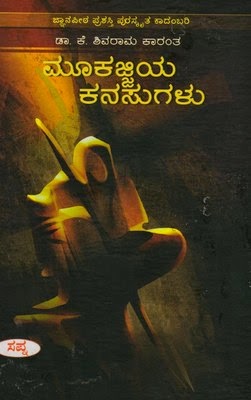
Book Review #16: Mookajjiya Kanasugalu By Dr. K. Shivaram Karanth

Every Indian who grew up watching some of the notable authors getting conferred with Jnanpith_Award sometime or the other. Usually, this award will be given to the authors for their notable literary works. The regular held notion of any of the Indian readers that, to win a prestigious award like Jnanpith, the author has to write a voluminous book that lasts hundreds and hundreds of pages. Well, I can't completely agree or disagree with that. The reason being, the book which I am reviewing in this post.

Dr. K. Shivaram Karanth, Kannada's renowned author was awarded with the Jnanpith for this book Mookajjiya_Kanasugalu in the year 1977. This book is just about 270+ pages, but, the quality of the writing and the plot of the novel is epic. Novel is very profound and thought provoking which actually makes the reader to question themselves about various basic questions of everyday life, like God, Culture, Belief, Sacred texts, Bhagawad Geeta, Death, Rebirth, Evolution etc, etc..

The title of the novel can be translated to english as "Grand Nanny's Dreams". The heroine of the novel is an 80 year old grandma named Mookambike who is the grandmother of Subraaya, the 2nd protagonist of the novel. Story which is set in a village called Mudur which is near to Shimoga district of Karnataka.

This book narrates the interaction of the grandma Mookajji and her grandson Subraaya about various subjects and situations. Subraaya poses various questions to his grandmother and through her response author tries to convey his ideas about the various topics in an easy and understandable way. Author's thought about the various subjects like God, Culture and other aspects is very elegant.

The journey takes the reader like a smooth wave of wind in every page and makes the reader to longe for more questions that Subraaya must ask his grandma. Readers will be so engrossed and wish even they must have such a grandma after all.!!. Though there are multiple characters in the book, the book mainly focuses on Subraaya and his questions for his grandmother and of course her answers. Subraaya is an educated man, but decides to stay in the village by looking after his land and farms. But his college degree in history makes him to learn more about history and he always believed that, his village Mudur has a long lasting history of more than 1000 years. He often tries to go into forests and caves around his village and collect some of the old artifacts and show it to his grandmother to know the details of those items. He always beleived that, his grandmother had special magical powers that, with just a touch of things, she can able to recall most of the history behind those artifacts. This special quality of Mookajji what attracted Subraaya, that made him to pose hundreds of questions everyday. At the same time, Mookajji is happy to answer all of his question in her own way which is the lucid part of the novel.

The best takeaway from the book is when Subraaya poses questions on God's existence and the answers given by granny Mookajji in her own way makes the reader to chuckle. Mookajji had her own belief and stories about Idol worship, Tantric experts, Jainism and Buddhism. According to the book, Mookajji was able to visualise many of the things as if it is happening in front of her eyes. These events made Subraaya to ask many questions and he enjoyed the various stories told by his granny.

Overall, going by the content and quality of the book and the simple way it was presented, I recommend every reader who is really eager to read yester year's kannada books, must read this awesome book. It has lots of comic incidents and more than that, it has food for thought for the readers. I will assure you that, the time you spent on reading this book will not go wasted. It increases your perception and gives you a new ray of light for looking the things that you have seen all these years, in a different way. The Jnanpith award for this book is greatly justified. Author had shown us the way, in which, even the most complex thoughts and ideas can be presented in a simple, understandable way.

My Rating: 5/5