Showing posts with label Shubha Vilas. Show all posts

Wednesday, March 23, 2016

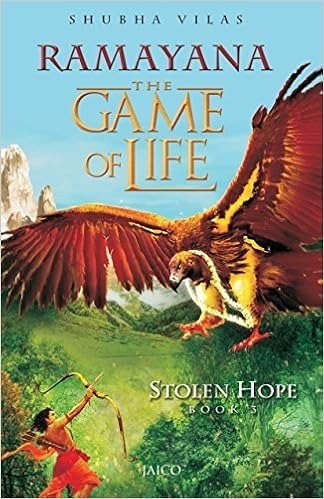
Book Review #81: Stolen Hope: Ramayana Series: Book #3: By Shubha Vilas

Title: The Stolen Hope (Book 3: Ramayana Series)
Author: Shubha Vilas
Publisher: Jaico Publishing
Genre: Mythology
Pages: 300+ (Paper bound)
Source: Review copy by the author


After receiving this book from the author for the review, I’ve thought for a while and purchased the first two books in the series (The Rise of the Sun Prince, and The Shattered Dreams) to get along with the plot and the subplots. Though as an Indian, I’ve known the entire story of the Ramayana and how it had happened by reading numerous books, this book series seems to be very specials regarding its authentic style of narration and the anecdotes, life lessons explained in every page of the book.

The book 1 explains about the birth and growth of the Rama as a toddler to a responsible scion. The book 2 explains the details about the decision of the King Dasharath to coronate Rama as the next king of Ayodhya, and the later events of Kaikeyi asking her two boons from the King Dasharatha resulting in the banishment of Rama to the exile for 14 years and Bharata to be made as a King of the Ayodhya, hence the dreams of the Dasharatha has shattered.

The book 3 begins from the story of the Dandakaranya where Rama, Sita and Lakshmana planned to spend their exile of 14 years. The journey of all three in the forest, their encounters with several rakshasas, and meeting several learned rishis like Agastya, and also the intervention of the Surpanakha and a small fun incident with her that turned out to be a major breakthrough in the story has been captured brilliantly by the author. The killing of Surpanakha’s cousins Khara and Dushana in an epic battle, and a beautiful narration of Rama meeting Shabari has been explained elegantly.

With a brief history of Ravana the story moves on stealthily and Rama is urged to go after the golden deer who is actually Maricha. Then Sita urges Lakshman to go after Rama despite of his unwillingness after hearing her husband's cry.

Ravana comes in form of sinister sage and he praises Ravana and belittle Rama, but Sita praises Rama instead which infuriates Ravana and he takes away Sita. Sita could only inform Jatayu about her abduction. Rama is informed about the abduction by dying Jatayu. Rama meets Shabri who tells them that only Vali can help him find Sita.

There is a short part of story from Lakshman's point of view too.

In-between the relay of the events, the author discusses and analyses certain acts of characters. For instance, at one place, Sita boldly reveals her mind to Rama about choosing the ascetic life instead of his bow and arrow, and immediately the next moment, she could not hold his gaze and begins to stare at her palms. That is, she feels guilty to have counselled Rama. Here the author discusses Sita's act of giving feedback as follows:

Does one have the right authority to give the feedback?
Even if one has the right authority, does one have the right motive to give a feedback?
Even if one has the right authority and motive, is it the right time, place and circumstance to give the feedback?

Although this story is written in parts, it doesn’t feel like it is limited to any particular storyline dividing the epic. The addition of little less important stories all along the way across the entire book has added much value as it would be very useful for the first time readers to obtain sufficient knowledge about the epic. The book is written in a gripping way that it is hard to keep it down, but it seems to be little bit lengthy as we tend to study each and every footnote at the bottom. But to a normal reader the footnotes would provide a Maslin of thoughts which will be forgivable for the length of the reading time.

This book is a must for the readers those who want to know about the Ramayana. Also the author has made this one to be a useful notes by sharing his wisdom and thoughts in every page. Further the summary of the books at the inception of the book makes it clear for the new readers that it’s not a must to read the other two initial books to get a clear view about this particular book.


My Rating:

5/5

Book Review #80: Shattered Dreams: Ramayana Series: Book #2: By Shubha Vilas

Title: The Shattered Dreams
Author: Shubha Vilas
Publisher: Jaico Publishing
Genre: Mythology
Pages: 250+ (Paper bound)
Source: Personal Copy

The first book in the series (The Rise of the Sun Prince) will end on a happy note of 12 years of successful marriage of Rama to Sita. They enjoy each and every day like never before. They were the true testimonial of how a married couple should behave towards each other. The book also explores further into the growing up Rama where he takes his responsibilities seriously and serves his elders with utmost respect. All days were passed without any deviations. People of Ayodhya were able to lead a peaceful and prosperous life until the King Dasharatha decides to coronate his son Rama as the next heir apparent of the Ayodhya.

The Shattered Dreams narrates the entire story of how the unblemished Rama was unfortunately awarded the exile of 14 years. How the deceitful Manthara was successfully able to brainwash Queen Kaikeyi by asking her to remember her two boons from Dasharatha that he had promised her long back.

The story in this book showcases the sacrifices made by many people including Rama who happily agreed to go to the forests for 14 years without even asking a single reason. He had respected his father Dasharatha’s words by every bit of it. Sacrifices made by Sita who readily asked Rama to take her to the forests along with her. Though she was never accustomed to the life of forests, she lived up to her name following the Dharma as a loyal wife of Rama. Apart from these, there is a radiant Lakshmana who accompanied Rama and Sita despite the strong protests from both. And lastly, we should never forget the sacrifice made by the wife of Laskmana’s wife Urmila. She readily agreed to stay back and look after her aged and widowed mother-in-law’s and wished all the success to her husband Lakshmana.

All said and done, the conduct of Bharata is worth to mention here. He readily disagrees with his mother Kaikeyi and repents for not being around in Ayodhya when all these things has happened without his knowledge. He ridicules his mother and tries all his might to get his beloved brother Rama back to Ayodhya. When Rama declined to the requests of Bharata, Bharata made sure that he also never steps in to Ayodhya. He constructed a small hut outside Ayodhya and placed Rama’s footwear on the throne and was ruling the kingdom on behalf of Rama.

Though we have grown up hearing this epic from various sources and watching many television series covering the same but after reading this book, one would definitely understands the real meaning of the tale and how it can be adopted to real life scenarios.

The footnotes and anecdotes in every page is the biggest plus point in this book. It adds a great value to the story. The notes are very educative, knowledgeable and a great source of quotes for those who are quote collectors. There are also great leadership and management lessons given under various circumstances. Two particular incidents worth to be mentioned on this aspects are the questions that Bharata asks himself whether he is eligible to rule the kingdom and the other scenario where Lakshmana asks himself whether he is allowed to advice Sita or Rama.

Overall, I have experienced a very new tale of Ramayana. Leaving its main plot as a known phenomenon, I have also had the fortune of reading many sub-plots and intricate details of the Ramayana. This book series is a must read to get a new perspective of how to look at things from a more broader perspective and definitely an eye opener towards myriad duties and responsibilities which we forget to value at times.

My Rating:

5/5

Tuesday, February 2, 2016

Book Review #79: Ramayana: The Game of Life – Book 1 – Rise of the Sun Prince

Title: Ramayana: The Game of Life – Book 1 – Rise of the Sun Prince
Author: Shubha Vilas
Publisher: Jaico Publishing House
Year: 2013
Genre: Hindu Scripture/Epics
Pages: 256 (Paperbound)
Source: Personal Copy

Ramayana is a story that has seeped into every soul of Hindustan. Ramayana is no longer a mere story to read and forget. There is so much to learn from these epics and can be easily adopted into our daily lives. Many books have come and gone, and each of those books adds a taste and personal viewpoint. As a reader, I feel fortunate enough to read many version of Ramayana.

Shubha Vilas has drawn inspiration from the original author of the Ramayana, Sage Valmiki and tried to present us a best possible version of the epic. The little anecdotes and footnotes explaining the real story and the interpretation of that particular event related to the modern day world is a good way of showing how Ramayana can be seen and adopted into our lives. Shubha Vilas has broken this epic in to a series of 5 books, of which, the first book which covers the birth of the protagonist of Ramayana, Lord Sri Rama.

This book mainly covers the Bala-Kanda of Ramayana i.e. the childhood days of Rama. But, the author puts it in a different way. As per this book, the Bala-Kanda refers to the days of sage Vishwamitra, the spiritual guru of Rama. The book entirely focuses on the birth origins of Rama and his brothers Lakshmana, Bharata and Shatrughna. Also, it covers how Vishwamitra became the celebrated Bramharshi after failing to seek revenge against his arch rival, the ever greatest sage, Bramharshi Vashishta.

The book has been written a lucid manner. Once you start reading it, you won’t feel like to stop it in midway. It keeps its readers hooked to the book. The book has been organized into main chapters and subchapters. Including the tale of Ramayana, the book also presents us with the many short stories that directly or indirectly linked to the Ramayana. One such stories is of Ahalya’s curse by her husband and Killing of the demons Maricha, Subhahu and Tadaka. The fascinating tale of how Vishwamitra became the revered Bramharshi by doing severe austerities and the sad story of Trishanku being held upside down for his lifetime in the heaven created by the sage Vishwamitra, etc… Each and every story happened outside the purview of Rama has been linked in one or the other way to Ramayana.

As the story keeps running further, we get the read the stories of how Rama and his brothers have grown up from being toddlers to infants to teenagers. As expected, we also read about Vishwamitra’s visit to Ayodhya to ask King Dasharatha to send his son Rama with him to achieve some predestined tasks.

The books ends on a happy note of the wedding proceedings of Rama with Sita. The stories of breaking the Bow by Rama and an encounter with his predecessor Parashurama will add a good factor to see Rama’s growth as a divine incarnation. Finally, the book ends when Dasharatha reeling from a nightmare decides to coronate Rama as his successor to the throne.

A nice start to this series. What’s more interesting from this book is the regular footnotes that you read at almost every page. The interpretation of the story or a particular event and how it can be juxtaposed to the modern day is a true testimonial of the author’s command over the Ramayana. If you are planning to read a condensed yet a riveting tale of the Ramayana, then you can begin with this book. I highly recommend this book.

My Rating:

5/5